Teacher to the Political Arena: The Long Journey of Mirza Fakhrul Islam AlamgirTeacher to the Political Arena: The Long Journey of Mirza Fakhrul Islam Alamgir
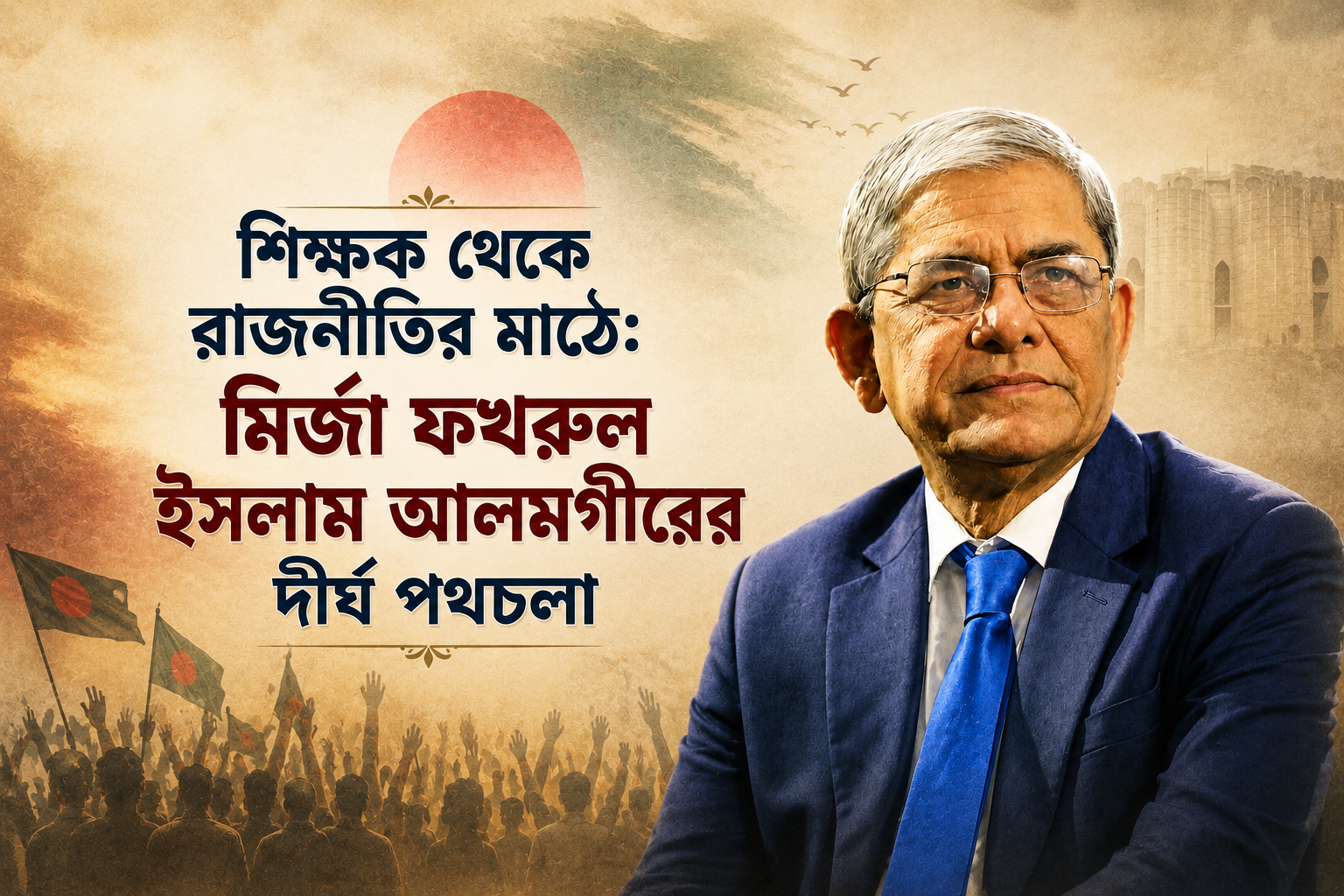
Teacher to the Political Arena: The Long Journey of Mirza Fakhrul Islam Alamgir

Published: 01:44 9 July 2026
Introduction
Mirza Fakhrul Islam Alamgir is one of the most prominent and influential figures in contemporary Bangladeshi politics. For many years, he has served as Secretary General of the Bangladesh Nationalist Party, widely known as the BNP. Through periods of political unrest, mass movements, legal cases, imprisonment, disputed elections and intense debate over democracy, he has remained one of his party’s most visible voices.
His life is not merely the story of a politician. It is also the story of a teacher, government official, local government representative, Member of Parliament, former state minister and long-serving opposition leader.
From the classrooms of Dhaka College to the streets of political movements, Mirza Fakhrul’s journey has passed through several important chapters of Bangladesh’s history.
Birth and Family Background
Mirza Fakhrul Islam Alamgir was born on 26 January 1948 in Thakurgaon.
He grew up in a family with a political and social background. His father, Mirza Ruhul Amin, was involved in politics. As a result, Fakhrul was exposed from an early age to discussions about society, politics, public service and the rights of ordinary people.
The rural environment of Thakurgaon also had a significant influence on his early life. The struggles of ordinary people, the realities of rural Bangladesh and the political environment around him helped shape his outlook.
However, despite growing up in a political family, he did not immediately choose politics as a full-time profession. His early career was closely connected with education and public service.
Education and Student Life
Mirza Fakhrul Islam Alamgir studied economics at the University of Dhaka. He completed both his honours and master’s degrees in economics.
His years at the university were politically important. During his student life, he became active in politics and was associated with the then East Pakistan Students Union.
He also served as General Secretary of the SM Hall unit at the University of Dhaka.
The late 1960s were a highly significant period in the history of the region. Political movements were growing, students were becoming increasingly active and demands for democratic rights were gaining strength.
Mirza Fakhrul became involved in the political movements of that period.
Role During the 1969 Mass Uprising
The 1969 Mass Uprising was one of the most important political movements before Bangladesh’s independence. Students and ordinary citizens took to the streets demanding political rights and an end to authoritarian rule.
Mirza Fakhrul Islam Alamgir was politically active during this period.
The experience of student politics and the mass movement had a lasting influence on his political thinking. Questions of democracy, political rights, accountability and public participation later became recurring themes in his political career.
His involvement in the political struggles of the 1960s also gave him early experience of political organisation and activism.
Teaching Career and Entry into Public Service
Before becoming a full-time politician, Mirza Fakhrul Islam Alamgir built a career in education.
In 1972, he began his professional career as a lecturer in economics at Dhaka College. He later worked in different government colleges as a member of the education cadre.
His teaching background remains one of the distinctive features of his political identity.
Unlike many politicians who entered public life directly through party structures, Mirza Fakhrul spent years in classrooms and government service before taking up politics as a full-time career.
In addition to teaching, he also held administrative responsibilities. His work in government institutions gave him practical experience of public administration, policymaking and the functioning of state institutions.
This background later became visible in his political style. He became known for explaining political issues in a relatively detailed and analytical manner.
From Government Service to Active Politics
Mirza Fakhrul eventually left government service and entered active politics.
His political journey did not begin directly at the highest level of national politics. Instead, he first built his position through local government and regional politics.
In 1988, he was elected Chairman of Thakurgaon Municipality.
This was an important turning point in his career. As a local government representative, he gained direct experience of the problems faced by ordinary citizens.
Local government work brought him closer to issues such as infrastructure, public services, development needs and local administration.
This experience helped him build a political base in Thakurgaon and gradually opened the way for his rise in national politics.
Rise in BNP Politics
During the early 1990s, Mirza Fakhrul Islam Alamgir became increasingly active in the Bangladesh Nationalist Party.
In 1992, he became President of the Thakurgaon District BNP.
His rise from district politics to the central leadership of the party was gradual. He spent years working at the local and organisational levels before becoming one of the most important figures in the BNP.
This long organisational journey became one of his political strengths. He understood both local-level politics and the challenges of national party leadership.
Member of Parliament and State Minister
In the 2001 general election, Mirza Fakhrul Islam Alamgir was elected as a Member of Parliament from the Thakurgaon-1 constituency.
Following the election, the BNP-led government appointed him State Minister for Agriculture.
Agriculture is one of the most important sectors of Bangladesh’s economy. His responsibilities brought him into contact with issues related to farmers, agricultural production, food security and rural development.
He later served as State Minister for Civil Aviation and Tourism.
These two ministerial positions gave him experience in very different sectors of government. While agriculture was closely connected with rural livelihoods and food production, civil aviation and tourism involved infrastructure, international connectivity and economic development.
His ministerial career added administrative experience to his political background.
Rise to the BNP’s Central Leadership
The political importance of Mirza Fakhrul increased significantly after 2009.
At a time when the BNP was facing major political and organisational challenges, he emerged as one of the party’s most visible leaders.
In 2011, following the death of Khandaker Delwar Hossain, Mirza Fakhrul became the Acting Secretary General of the BNP.
For several years, he carried out the responsibilities of the position in an acting capacity.
In 2016, he was formally appointed Secretary General of the BNP.
His rise to the position came at a difficult time for the party. BNP Chairperson Khaleda Zia faced legal and health problems, while Tarique Rahman remained abroad. Many senior leaders and activists also faced arrests and legal cases.
Under these circumstances, Mirza Fakhrul became one of the main public faces of the BNP.
The Public Face of the BNP During a Difficult Period
As Secretary General, Mirza Fakhrul had several major responsibilities.
He regularly spoke at press conferences, public meetings, political rallies and diplomatic events. He communicated the party’s positions on elections, democracy, political rights and government policies.
During years of political pressure, he also had to maintain communication between the central leadership and grassroots activists.
For many BNP supporters, he became a symbol of the party’s survival during a difficult period.
His political role became particularly important when Khaleda Zia was unable to participate fully in active politics.
Political Movement During the Awami League Era
During the long period of Awami League rule, the BNP repeatedly raised demands for voting rights, democratic reform and an election-time neutral government.
Mirza Fakhrul Islam Alamgir was one of the leading voices behind these demands.
He participated in rallies, marches, political meetings and other programmes organised by the BNP.
The elections of 2014 and 2024 became major points of political disagreement. The BNP boycotted both elections and continued to demand a neutral election-time arrangement.
During this period, Mirza Fakhrul frequently argued that a credible election was necessary to restore public confidence in the political system.
Legal Cases, Arrests and Imprisonment
One of the most significant parts of Mirza Fakhrul’s political life has been his repeated experience of legal cases, arrest and imprisonment.
During years of political conflict, he faced numerous cases connected with opposition movements and political programmes.
A major episode came after the BNP’s mass rally in Dhaka on 28 October 2023.
Following violence and clashes surrounding the political programme, Mirza Fakhrul was arrested the next day.
He was sent to prison and remained behind bars during a highly sensitive period ahead of the 2024 general election.
His arrest attracted significant attention because he was the Secretary General of the country’s largest opposition party.
Supporters of the BNP described the cases and arrests as part of political repression. The government and law enforcement authorities, however, defended legal actions as part of the normal judicial process.
The period remains an important and disputed chapter in Bangladesh’s recent political history.
A Long Struggle for Voting Rights and Democracy
A major theme of Mirza Fakhrul’s political career has been his demand for what he describes as the restoration of democracy and voting rights.
For years, he argued that elections should be competitive, inclusive and credible.
He also repeatedly called for political dialogue and reforms to restore confidence in state institutions.
His supporters view this consistency as one of his major political contributions.
Critics, however, argue that the BNP’s political strategies did not always produce the desired results and that the party sometimes failed to develop effective alternatives.
Despite these criticisms, Mirza Fakhrul remained one of the most persistent voices in opposition politics.
The July Uprising and a New Political Reality
In July 2024, a student movement over public-sector job quotas began to grow across Bangladesh.
What started as a student-led movement later expanded into a much broader uprising involving people from different sections of society.
The movement reached a historic turning point in August 2024.
The July Uprising created a new political reality in Bangladesh.
It is important to recognise that the uprising was primarily driven by students and ordinary citizens. Therefore, its entire credit cannot accurately be given to any single political party or leader.
However, opposition political parties, including the BNP, supported the movement’s broader demands.
Mirza Fakhrul Islam Alamgir publicly expressed support for the democratic aspirations of the movement and continued to speak about political change, voting rights and accountable government.
Mirza Fakhrul’s Contribution to the July Movement
Mirza Fakhrul’s role in the July Uprising was different from that of the student leaders who directly organised the movement.
His role should be understood within the broader political context.
For years before the uprising, he had been part of a sustained opposition movement against the Awami League government.
He and his party had repeatedly raised questions about elections, democratic space, political arrests and voting rights.
When the student movement grew into a nationwide uprising, the BNP extended political support to the broader movement.
After the political change, Mirza Fakhrul became one of the strongest advocates of a clear democratic transition and a credible national election.
His position was that the aspirations created by the uprising should ultimately lead to a representative political system.
His Major Political Contributions
Mirza Fakhrul Islam Alamgir’s political contributions can be assessed from several perspectives.
First, he helped keep the BNP organisationally active during one of the most difficult periods in the party’s history.
Second, he became the party’s main public voice when several senior leaders were absent from active politics.
Third, he consistently raised the issues of elections, voting rights and democratic institutions.
Fourth, he maintained communication with political parties, civil society groups and foreign diplomats during periods of intense political tension.
Fifth, his experience in teaching, administration, local government, Parliament and the cabinet gave him a broad understanding of state affairs.
Sixth, he played a major role in keeping the BNP’s political message visible during years of opposition.
His Political Style
Mirza Fakhrul is generally known for a relatively calm and restrained speaking style.
Bangladesh’s politics is often highly confrontational. Political speeches can be aggressive, personal and emotional.
Within this environment, Mirza Fakhrul has developed a reputation for using comparatively measured language.
His background as a teacher is often reflected in his speeches. He frequently uses historical references and political explanations to present his arguments.
This does not mean that his speeches are free from strong criticism. He has often strongly criticised his political opponents. However, his tone is generally seen as different from that of many more confrontational political figures.
Strengths as a Political Leader
One of Mirza Fakhrul’s greatest political strengths has been patience.
He spent many years working through different levels of politics before reaching the top leadership of his party.
Another strength is organisational endurance. He remained in a central leadership role during a period when the BNP faced arrests, legal cases, internal pressure and electoral setbacks.
His supporters also point to his personal behaviour and public communication style as important qualities.
He has also benefited from experience in several different areas of public life.
Few politicians have worked as a teacher, government official, municipal chairman, Member of Parliament, state minister and opposition party Secretary General.
Criticism and Political Controversies
Like every major political leader, Mirza Fakhrul Islam Alamgir has faced criticism.
Some critics argue that the BNP’s movements under his leadership did not always achieve their immediate political objectives.
Others have questioned the party’s decisions to boycott elections and its strategies during major political crises.
Questions have also been raised about the effectiveness of opposition alliances and the BNP’s long-term political planning.
His supporters, however, argue that he led the party under extraordinary pressure and that maintaining the organisation itself was a major political achievement.
These different views remain part of the debate over his political legacy.
A Journey Through Several Eras of Bangladesh
Mirza Fakhrul Islam Alamgir’s life has crossed several major periods of Bangladesh’s history.
He witnessed the political movements of the 1960s.
He was politically active around the time of the 1969 Mass Uprising.
He began his professional life after Bangladesh’s independence.
He entered local government politics during the military rule of the 1980s.
He rose in national politics during the restoration of parliamentary democracy.
He served in government between 2001 and 2006.
He later became one of the country’s leading opposition figures during the long Awami League era.
Finally, he witnessed the July Uprising and the political transformation that followed.
This long journey makes his life closely connected with the broader political history of Bangladesh.
Important Events in Mirza Fakhrul’s Life: Timeline
1948: Born in Thakurgaon on 26 January.
1960s: Studied economics at the University of Dhaka and became involved in student politics.
1969: Took part in the political movement surrounding the Mass Uprising.
1972: Began his professional career as a lecturer in economics at Dhaka College.
1970s and 1980s: Worked in education and government administration.
1988: Elected Chairman of Thakurgaon Municipality.
1992: Became President of the Thakurgaon District BNP.
2001: Elected Member of Parliament from Thakurgaon-1.
2001–2006: Served as State Minister for Agriculture and later State Minister for Civil Aviation and Tourism.
2009: Rose to a senior position in the BNP’s central leadership.
2011: Became Acting Secretary General of the BNP.
2016: Formally became Secretary General of the BNP.
2023: Arrested following the political crisis surrounding the 28 October BNP rally.
2024: Supported the broader democratic aspirations surrounding the July Uprising and later called for a clear political transition.
Why Mirza Fakhrul Remains Important in Bangladesh Politics
Mirza Fakhrul remains important because his career connects several generations of Bangladeshi politics.
He began his political journey as a student activist and later became a teacher.
He entered local government before moving to Parliament and the cabinet.
He then spent years as one of the country’s leading opposition figures.
This combination of experience is unusual.
His importance also comes from the fact that he led the BNP’s public political activities during one of the most difficult periods in the party’s history.
Whether one supports or opposes his politics, his role in Bangladesh’s recent political history is difficult to ignore.
Conclusion
The life of Mirza Fakhrul Islam Alamgir is deeply connected with the political history of Bangladesh.
From his childhood in Thakurgaon to student politics at the University of Dhaka, from the 1969 Mass Uprising to a career in teaching, from local government to Parliament and from the cabinet to the leadership of the opposition, his journey has been long and eventful.
He became Secretary General of the BNP at a time when the party faced some of its greatest challenges.
During years of political pressure, arrests, legal cases, disputed elections and organisational uncertainty, he remained one of the party’s most visible leaders.
His role in the July Uprising should be understood carefully and historically. The uprising was primarily led by students and ordinary citizens. Mirza Fakhrul’s contribution came through the broader opposition movement, political support for democratic change and his long-standing demands for voting rights and credible elections.
His supporters regard him as a patient, educated and restrained politician who kept his party together through difficult times.
His critics question the effectiveness of some of the BNP’s political strategies and decisions.
Both views are part of his political story.
What is clear is that Mirza Fakhrul Islam Alamgir has spent decades at the centre of Bangladesh’s changing political landscape.
His final place in history will depend not only on the struggles he has already faced, but also on the role he plays in strengthening democracy, accountable government, political tolerance and public institutions in the years ahead.
Advertisement
Most Readed - Biography



- Ronaldo shares emotional message upon Messi's retirement, expressing 'utmost respect'
- Nude Trump Sculpture ‘The Orange Plague’ at the European Parliament
- Jamuna Fertilizer Factory Shuts Down Again Just Two Days After Resuming Operations
- Over 100 minutes of footage cut from Rajinikanth’s ‘Jailer 2’
- Messi bids farewell with a goal and assists, showered with love by teammates
- US troops in Okinawa face curfew and alcohol ban following murder case
- 7 Years Since Abrar Fahad's Murder: Family Frustrated by Lack of Final Justice
- Barça's Rampage in Women's El Clásico: Real Crushed 7-0
- Koel Mallick Joins BJP and Becomes Rajya Sabha Candidate
- End of a 10-Year Relationship: Pritom and Shehtaz Part Ways
- No Relief in Fish, Chicken and Egg Prices, Low-Income People Under Pressure
- Price of Low-Tier Cigarettes Raised Again; 10 Sticks Now Cost Tk 65
- Love, Resentment and ‘Write to the Address of the Sky’: The Untold Story of Rudra and Taslima
- Squad Trimmed: Six Players Dropped from Bangladesh's ASEAN Cup Team
- RAB Dissolved, SRB Begins Operations; Uniforms, Logos, and Vehicle Colors to Change
- "Jinnah's father sold fish; he was a Hindu": Fazlur Rahman's claim vs. historical records
- Bangladesh Bank to provide up to Tk 20 lakh without collateral; here is which young entrepreneurs are eligible.
- Raphinha Equals Messi's Record; Barcelona Makes History in 7-Goal Thriller
- Major blow for international students: Australia limits opportunities to bring families
- Sakib Ali: A Prominent Name in Bangladesh’s Diplomacy and Politics