July Movement Coordinator to Member of Parliament: The Complete Biography of Hannan Masud
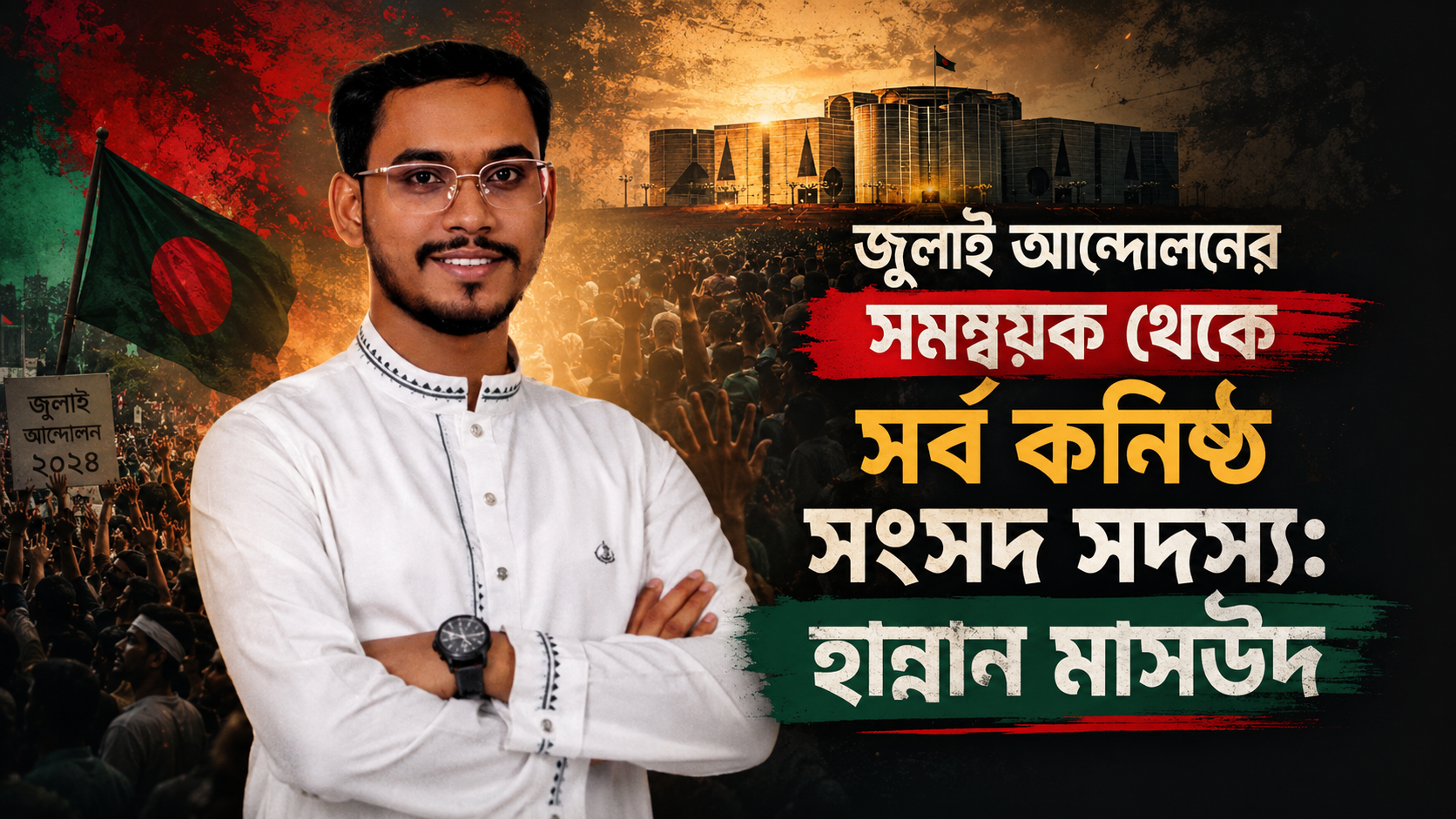
July Movement Coordinator to Member of Parliament: The Complete Biography of Hannan Masud

Published: 06:03 12 July 2026
Abdul Hannan Masud is one of the young figures who rose to prominence during Bangladesh’s recent political transformation. Born in the island upazila of Hatiya in Noakhali, he first became known as a student of the University of Dhaka. He later gained national recognition as a coordinator of the 2024 quota reform movement and the July uprising.
Following the political transition, he became the chief organiser of the Anti-Discrimination Student Movement. He later moved from student activism into formal party politics, taking a senior leadership position in the National Citizen Party, or NCP. In the 2026 parliamentary election, he was elected from the Noakhali-6 constituency, which covers Hatiya.
He is now known both as a young Member of Parliament and as a central leader of a newly established political party.
Birth and Family Roots
Abdul Hannan Masud was born in Burirchar Union of Hatiya Upazila in Noakhali. Recent electoral and biographical profiles mention his date of birth as January 1, 2000. However, an older public profile lists May 12, 1998.
Because of this difference, his exact date of birth remains unclear in publicly available sources. Until an official document is released, the year 2000, which appears in more recent profiles, is generally used.
According to published profiles, his father’s name is Amirul Islam Mohammad Abdul Malek, while his mother’s name is Ayesha Khatun Bilkis. His father has reportedly been involved in agriculture.
Reliable mainstream reports do not provide detailed information about his mother’s profession, the number of siblings in the family or their broader financial condition.
Various social media accounts describe him as the son of a farming or ordinary family. However, verified information about the family’s income, property, childhood financial struggles or how his education was funded remains limited.
For that reason, it would not be professionally responsible to describe him as someone who rose from extreme poverty without strong supporting evidence.
Childhood and Upbringing in Hatiya
Abdul Hannan Masud spent his childhood in Hatiya. Life in Burirchar and other island and char areas of Hatiya has long been shaped by rivers, boat transportation, natural disasters and difficult connections with the mainland.
Growing up in such an area may have allowed him to observe local problems involving transport, education, healthcare and access to government services from an early age. However, this is a reasonable inference based on the geographical conditions of the region, not a claim directly supported by a detailed autobiographical interview.
Publicly available sources do not clearly explain what he was like as a child, whether he participated in sports or cultural activities, or how teachers and friends viewed him during his school years.
His political rise is relatively recent, and no major investigative biography has yet documented his childhood and adolescence in depth.
His later public activities, however, show skills in organising people, making quick decisions, delivering speeches and communicating with different groups.
It is not possible to confirm whether these abilities developed during his school years, but they became important parts of his political identity after he entered university.
Primary, Secondary and College Education
Reliable public information about Abdul Hannan Masud’s primary school, secondary school and college is limited.
Some online posts mention the names of educational institutions, but these claims are not consistently supported by official records or credible media reports.
There is also no verified information about his SSC or HSC results, GPA, academic awards or other achievements during school and college.
It would therefore be inaccurate to describe him as a top-ranking student or an exceptionally gifted learner from childhood without documentary evidence.
What is known is that he later secured admission to the University of Dhaka for higher education.
Moving from a remote island region to one of Bangladesh’s leading public universities was a major turning point in his life.
The university gave him not only access to higher education but also an environment in which he could engage with national politics, student rights and questions of inequality.
Education at the University of Dhaka
Recent electoral profiles have described Abdul Hannan Masud as an honours-level student at the University of Dhaka.
Information published in early 2026 stated that he was then studying in the third year of his undergraduate programme. However, his department or institute has not been clearly identified in several reliable reports.
His university life did not remain limited to classrooms, examinations and academic study.
A large part of his student life took place in the public sphere because of political campaigns, press conferences, movement-related announcements and leadership roles in national organisations.
Reliable information is unavailable about his academic results, class attendance or involvement in academic research.
However, during the movement, he demonstrated organisational ability by speaking to the media, explaining programmes and coordinating with activists across the country.
Balancing higher education with politics may now be one of his personal challenges.
After becoming an MP, he has to manage his studies, parliamentary responsibilities, party duties and constituency work at the same time.
Entry into Student Politics
It is unclear exactly when Abdul Hannan Masud first became active in student rights movements or whether he held formal membership in any political student organisation before 2024.
His national prominence mainly began during the quota reform movement of 2024.
When students renewed their protests over the government job quota system in July 2024, students from the University of Dhaka and other institutions organised under the platform known as the Anti-Discrimination Student Movement.
Abdul Hannan Masud emerged as one of the coordinators of that platform.
His responsibilities included publicising programmes, explaining the movement’s position, sharing information about detained students and announcing the next steps of the campaign.
These activities quickly made him one of the recognisable faces of the movement.
Role in the July 2024 Movement
As the July movement intensified, many students were arrested across Bangladesh.
During a virtual press conference on July 27, Abdul Hannan Masud claimed that more than 3,500 students had been detained nationwide.
He issued a 24-hour deadline demanding the release of arrested students, the return of missing individuals and the withdrawal of cases connected with the movement.
At the same press conference, he called for an independent investigation into deaths and violence during the protests, punishment for those responsible and the formation of a commission involving relevant stakeholders.
He also encouraged supporters to spread the movement’s message through online campaigns, wall writing and graffiti.
These actions highlighted both his public communication role and his organisational involvement.
He was also named as one of the coordinators of the “March for Justice” programme announced for July 31.
Students were asked to hold programmes at court premises, university campuses and roads across the country.
Teachers, lawyers, human rights activists and ordinary citizens were also invited to stand beside the students.
At the beginning of August, the movement announced a nationwide non-cooperation programme against the government.
Abdul Hannan Masud shared details of the programme through social media.
He called on people to avoid paying taxes and utility bills, keep different institutions closed and participate in the wider campaign.
By that time, the movement had expanded beyond the original demand for quota reform and developed into a broader anti-government political movement.
The 2024 uprising, however, cannot be credited to one individual.
It was a collective movement involving students from universities, colleges and schools, as well as professionals and ordinary citizens.
Abdul Hannan Masud was an important coordinator and organiser, but he was not the movement’s only leader.
New Responsibilities After the Political Change
After the political change of August 5, 2024, efforts were made to give the Anti-Discrimination Student Movement a more organised national structure.
A central convening committee was announced on October 22.
Hasnat Abdullah became convener, Arif Sohel became member secretary, Abdul Hannan Masud was appointed chief organiser and Umama Fatema became spokesperson.
An 18-member executive committee was later formed in November, while the four central office-bearers continued in their positions.
As chief organiser, Masud’s responsibilities included implementing central decisions, coordinating workers at district and regional levels and promoting the movement’s political goals.
At this stage, his speeches began focusing less on the quota issue and more on democracy, electoral rights, a new political arrangement and constitutional reform.
He gradually transformed from a student movement coordinator into an organiser speaking on national political issues.
Political Statements and Ideology
At an event in Noakhali in November 2024, Abdul Hannan Masud said that individuals involved in criminal activities should not be allowed to become chairmen, Members of Parliament or ministers.
He alleged that voting rights had been restricted under the previous government and called for state and constitutional reform.
His political speeches repeatedly emphasised democracy, voting rights, youth participation and the need to change the country’s traditional political culture.
At the same time, some critics have described his language as overly harsh and confrontational.
Questions have also been raised about whether it is democratic to judge every member of a political party or ideology in the same way.
Supporters argue that his direct and forceful language has made him popular among young people.
Critics say that to survive in national politics, he must move beyond the emotional language of protest and adopt a more inclusive, measured and evidence-based approach.
Joining the National Citizen Party
The National Citizen Party, or NCP, officially began its journey on February 28, 2025.
Abdul Hannan Masud became a senior joint chief coordinator in the party’s central leadership.
His public recognition during the movement and his organisational experience helped him secure a high-level position in the new political party.
The NCP presented itself as an alternative to traditional family-centred politics and described its agenda as reformist and youth-led.
Masud also spoke at meetings and rallies about training young people, encouraging social activities and building a new political culture.
The decision by student movement leaders to enter party politics created debate.
Some argued that joining formal politics was a natural and necessary step for movement leaders.
Others feared that a broad civic movement could become restricted by party interests after its leading figures joined a political organisation.
Personal Life and Marriage
According to published profiles, Abdul Hannan Masud married Shyamoli Sultana Jadni in 2025.
Some profiles state that Jadni was also involved in student and political activities.
However, reliable mainstream media reports provide little detail about how they met, the length of their relationship, the exact date of the marriage or the family arrangements surrounding it.
As a public figure, Masud has the right to decide how much of his private life he wishes to share with the media.
Unverified information about his wife or family members should not be presented as fact.
Candidacy for the Noakhali-6 Constituency
In the 2026 parliamentary election, Abdul Hannan Masud contested the Noakhali-6 constituency as an NCP candidate.
The constituency covers the entire Hatiya Upazila.
By contesting from his home region, he was able to campaign both as a nationally recognised July movement organiser and as a local son of Hatiya.
Transportation, river routes, education, healthcare, employment and local political influence were important issues during the campaign.
His national profile and role in the movement were among his biggest strengths as a young candidate.
His main limitation was his lack of long-term electoral and administrative experience.
According to updated result compilations, he received 91,899 votes.
His nearest opponent, Mohammad Mahbubur Rahman, received 64,021 votes.
Masud won by a margin of 27,878 votes.
Some early reports contained slightly different totals, but these figures appeared in later result compilations.
Rise as a Young Member of Parliament
After winning the election, Abdul Hannan Masud took office as a Member of Parliament in February 2026.
If the more recent information about his age is accurate, he is among the youngest members of the current Parliament.
Some profiles have even described him as the youngest MP in Bangladesh’s history, although that claim requires a full review of historical parliamentary records.
The responsibilities of a movement organiser and those of an MP are very different.
In a movement, the main tasks are mobilising people, raising demands and organising protests.
In Parliament, an elected representative must understand legislation, analyse budgets, question ministries, ensure accountability and monitor development plans for the constituency.
Masud’s political future will therefore not depend only on his identity as a July movement organiser.
His real leadership test will be how quickly he learns parliamentary procedures and how effectively he raises the practical problems of Hatiya at the national level.
Allegation Over Returning a Ferry and Recent Controversy
A new controversy involving Abdul Hannan Masud emerged in July 2026.
Passengers and ferry-related officials alleged that a ferry travelling from Chairman Ghat to Nalchira had been turned back from the river to pick him up.
A ferry official claimed that the vessel was ordered to return after the authorities were informed that the MP had arrived.
Passengers complained that returning the ferry during adverse weather caused delays and anxiety for ordinary travellers.
Masud offered a different explanation.
He said that he needed to travel to Hatiya for urgent official work and that the ferry had not gone far from the terminal.
He also alleged that misleading information was being spread about the incident.
There were differences between the accounts of the MP, ferry officials and witnesses over how long the vessel had been travelling before it returned.
The incident became an important test of his political image.
He emerged from a movement that had strongly criticised special privileges, inequality and the absence of accountability.
As a result, allegations that he personally received special treatment naturally created greater public scrutiny and criticism.
Public Identity in Bangladeshi Politics
For many Bangladeshis, Abdul Hannan Masud is primarily known as a young coordinator of the July movement.
His virtual press conferences, announcements of political programmes and demands for the release of detained students made him widely known during a difficult period of the protests.
His later roles as chief organiser, central NCP leader and Member of Parliament further expanded his political identity.
Supporters view him as courageous, outspoken and a representative of young people from the marginal island region of Hatiya.
Critics consider him politically inexperienced, overly confrontational in his language and eager to convert the movement’s popularity into political power.
Both assessments contain elements of truth.
He reached a major political position at a young age, but rapid political success does not automatically guarantee long-term achievement.
To maintain his position, he will need to demonstrate visible and accountable work in Parliament, within his party and in his constituency.
Patriotism and Political Philosophy
Patriotism cannot be proved only through speeches or party identity.
Masud’s supporters see his role in the July movement, his statements on voting rights and his efforts to present Hatiya’s problems nationally as signs of his commitment to the country.
His political philosophy focuses on a new political settlement, democracy, citizen participation and youth leadership.
However, these ideas will ultimately be judged through his actions.
Respect for opposing opinions, protection of minority communities, commitment to the rule of law, treatment of political rivals and avoidance of abuse of power will determine whether his political ideals are genuine.
Current Life and Responsibilities
As of July 2026, Abdul Hannan Masud is the Member of Parliament for Noakhali-6 and a senior joint chief coordinator of the National Citizen Party.
Parliamentary work, party programmes, communication with constituents and the development of Hatiya are now the main parts of his public life.
The people of Hatiya have long-standing expectations from their elected representative.
Safe river transportation, regular ferry and ship services, improved healthcare, better educational institutions, employment opportunities, protection from river erosion and disaster preparedness are among the major issues he must address.
As a central party leader, he must also prove that “new politics” means more than simply presenting new faces.
The NCP’s promise of a new political culture will become credible only if its leaders ensure transparency, internal democracy, respect for the law and equal treatment of ordinary citizens.
Conclusion
Abdul Hannan Masud’s journey from Burirchar in Hatiya to the University of Dhaka, the July movement, the leadership of the Anti-Discrimination Student Movement, a central position in the NCP and eventually the national Parliament is a remarkable story of Bangladesh’s recent political transformation.
One of his biggest strengths is the courage to speak publicly, communicate the message of a movement and take organisational responsibility at a young age.
However, his rapid rise has also created high expectations.
The movement from which he emerged demanded accountability, equality and a society free from discrimination.
Now that he is part of formal political power, he must demonstrate those same values through his own conduct.
Many details about his childhood, school years and family struggles remain unavailable to the public.
A professional biography must therefore maintain a clear distinction between confirmed information and assumptions.
These chapters of his life may become clearer if he gives a detailed personal interview or if official biographical records and family accounts are published in the future.
It is still too early to make a final judgment about Abdul Hannan Masud’s political career.
His future identity will depend on how effectively he works in Parliament, what changes he brings to the lives of the people of Hatiya, whether he promotes democratic practices within his party and whether he can distance himself from the special privileges of political power.
Advertisement
Most Readed - Biography



- Over 100 minutes of footage cut from Rajinikanth’s ‘Jailer 2’
- Messi bids farewell with a goal and assists, showered with love by teammates
- US troops in Okinawa face curfew and alcohol ban following murder case
- 7 Years Since Abrar Fahad's Murder: Family Frustrated by Lack of Final Justice
- Barça's Rampage in Women's El Clásico: Real Crushed 7-0
- Koel Mallick Joins BJP and Becomes Rajya Sabha Candidate
- End of a 10-Year Relationship: Pritom and Shehtaz Part Ways
- Prime Minister pledges to ensure quality housing for low-income people
- "Five Monumental stadiums would have been packed" for Messi's farewell match: Scaloni
- Angelina Jolie Shares Images of Devastation in Gaza, Calls for Urgent Aid
- No Relief in Fish, Chicken and Egg Prices, Low-Income People Under Pressure
- Price of Low-Tier Cigarettes Raised Again; 10 Sticks Now Cost Tk 65
- Love, Resentment and ‘Write to the Address of the Sky’: The Untold Story of Rudra and Taslima
- RAB Dissolved, SRB Begins Operations; Uniforms, Logos, and Vehicle Colors to Change
- Squad Trimmed: Six Players Dropped from Bangladesh's ASEAN Cup Team
- Russia proposes inclusion of Iran in Mecca defense pact
- Bangladesh Bank to provide up to Tk 20 lakh without collateral; here is which young entrepreneurs are eligible.
- "Jinnah's father sold fish; he was a Hindu": Fazlur Rahman's claim vs. historical records
- Sakib Ali: A Prominent Name in Bangladesh’s Diplomacy and Politics
- Raphinha Equals Messi's Record; Barcelona Makes History in 7-Goal Thriller