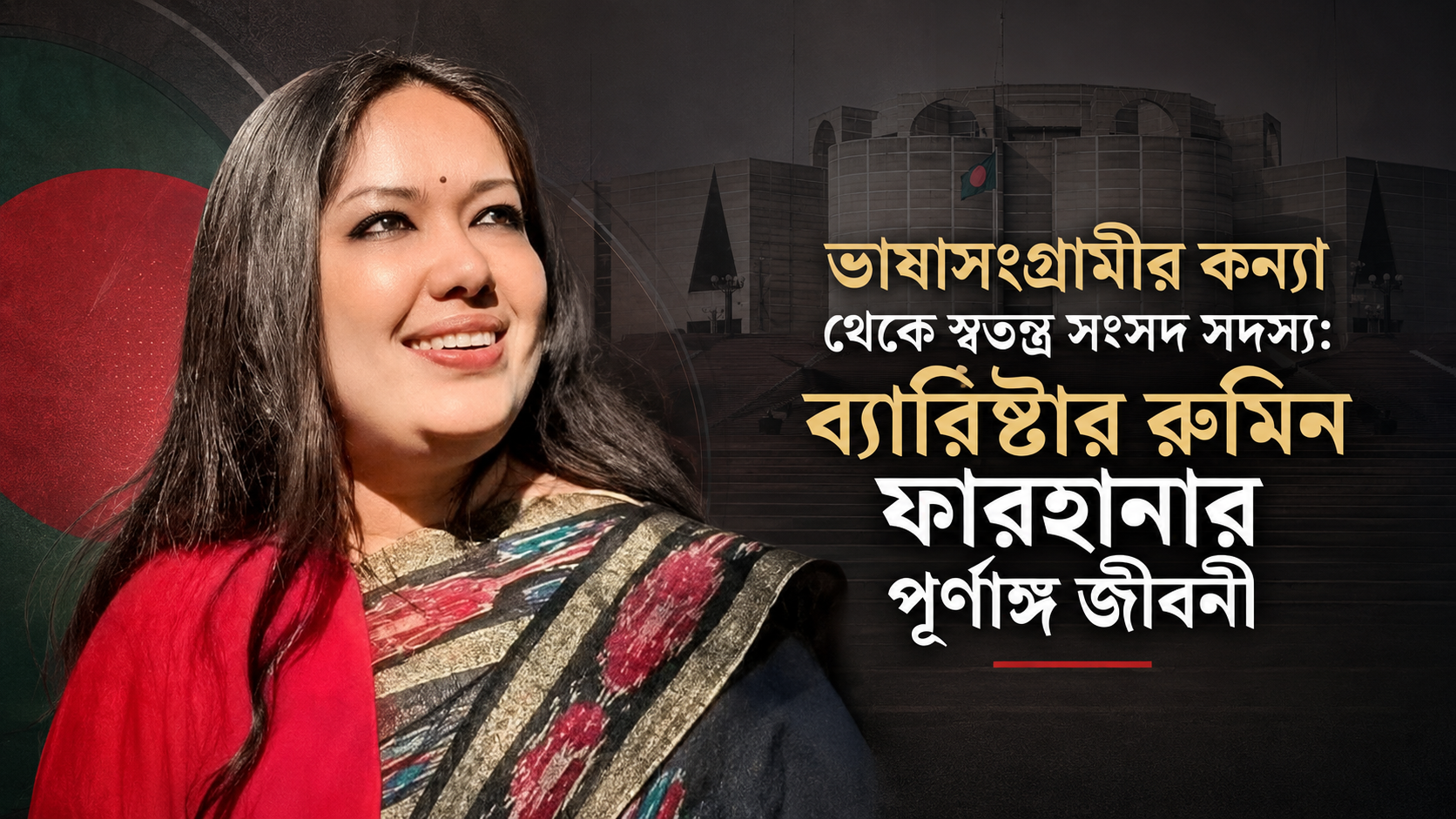
The Daughter of a Language Movement Leader to an Independent MP: The Complete Biography of Barrister Rumeen Farhana

Published: 11:51 14 July 2026
Barrister Rumeen Farhana is one of the most outspoken, argumentative and widely discussed female politicians in contemporary Bangladesh. Alongside her identity as a lawyer, she has gained national recognition through political television debates, parliamentary speeches and her strong criticism of the government. As the only daughter of Language Movement activist Oli Ahad, she grew up in an environment closely connected to politics and major national events.
After joining the Bangladesh Nationalist Party, she became the party’s assistant international affairs secretary. She entered Parliament through a reserved seat for women in 2019 and resigned in 2022 following a party decision. Later, after failing to secure the BNP nomination, she contested as an independent candidate and was expelled from the party.
Despite taking a major political risk, she won the Brahmanbaria-2 constituency as an independent candidate. She is now a directly elected Member of Parliament.
Birth and Family Background
According to published biographical information, Rumeen Farhana was born on August 19, 1981. Her family roots are in the Islampur area of Bijoynagar Upazila in Brahmanbaria district.
Her father was Language Movement activist and politician Oli Ahad, while her mother was Rashida Begum.
Rumeen grew up in a family where politics was a regular part of everyday life. Her father was not merely a political leader. He was also an active organiser in the movement demanding state recognition for the Bengali language during the Pakistan period.
Oli Ahad was among the founders of the East Pakistan Muslim Students’ League. He participated in various programmes connected with the Language Movement and was arrested for his political activities. He received the Independence Award in 2004 in recognition of his contribution.
Published profiles describe her mother, Rashida Begum, as an educated woman. However, detailed information about her mother’s role in Rumeen’s childhood, their family life and relatives is limited.
Rumeen is widely known as the only child of her parents. She has generally kept private family matters away from media attention.
The Political Legacy of Her Father, Oli Ahad
Understanding Oli Ahad’s political career is important for understanding Rumeen Farhana’s political journey.
Oli Ahad was involved in the Language Movement, the struggle for autonomy and democratic politics. Although he worked with different mainstream political groups at various times, he later developed an independent political position.
In Bangladesh’s first parliamentary election in 1973, Oli Ahad contested as an independent candidate.
When Rumeen later decided to contest an election independently, she referred to her father’s electoral struggle. She said she had learned from her family and political guardians how to stand alone against the political current.
Rumeen grew up in a deeply political environment. Her ancestral home falls within the current Brahmanbaria-2 constituency, and her family’s historic relationship with local residents contributed to the development of her political base.
Her father’s political identity may have opened some doors, but it also created high expectations.
Supporters view her as someone carrying the political legacy of a Language Movement leader. Critics argue that she must establish her position through her own work and political decisions rather than relying on family identity.
Childhood and Upbringing
Reliable reports provide little information about Rumeen Farhana’s daily childhood life, personality, friendships or the memories of her schoolteachers.
It would therefore be inaccurate to claim without evidence that she was an exceptional speaker, unusually rebellious or destined to become a politician from childhood.
However, growing up in a political family likely introduced her at an early age to the Language Movement, politics during the Pakistan era, the creation of Bangladesh, military rule, democracy and political repression.
Her later speeches demonstrate a strong interest in the country’s political history, Constitution and state institutions. The foundations of these interests were likely shaped by her family environment and legal education.
Her relationship with Brahmanbaria was not created only during election campaigns. Her family roots and the political memories associated with her father had long connected her with Islampur, Sarail, Ashuganj and nearby areas.
School and College Life
Published profiles state that Rumeen Farhana studied at Holy Cross School in Dhaka during her secondary education and later attended Viqarunnisa Noon School and College for higher secondary education.
However, detailed information about her examination results, academic sessions, extracurricular involvement or special achievements during school is not widely available.
There are also few documented interviews explaining what kind of student she was.
Her later achievement of receiving an international legal education and qualifying as a barrister shows that she continued through a long and demanding academic path.
The English-language environment, debate opportunities and analytical education available at her schools may have supported her later career in law and politics. However, without a detailed personal account from her, this cannot be stated with certainty.
Higher Education in Law
After completing higher secondary education, Rumeen Farhana studied law.
According to published information, she earned a bachelor’s degree in law under the University of London. She later completed the Bar-at-Law qualification through Lincoln’s Inn in the United Kingdom.
Lincoln’s Inn is one of the historic professional legal institutions connected with the training and recognition of barristers in England and Wales.
This education provided her with a professional foundation in the courts, constitutional law, state power, citizens’ rights and parliamentary processes.
After returning to Bangladesh, she joined the legal profession and reportedly practised in the higher courts.
She has also been listed as a member of the Dhaka Bar Association in published biographical sources.
Career as a Lawyer
Rumeen Farhana’s identity as a lawyer has remained an important part of her political image.
During television debates and parliamentary speeches, she frequently raises questions involving the Constitution, the rule of law, fundamental rights, elections and the justice system.
However, a complete public record of major cases handled by her, significant court victories or long-term work at a specific law firm is not available.
For this reason, she is better known as a legally educated politician and political commentator than as a courtroom lawyer famous for landmark cases.
Her knowledge of law has provided her with an advantage in political debates.
Her ability to explain complicated political issues in legal and constitutional terms has distinguished her from many other political speakers.
Writing and Media Recognition
Even before receiving a major position in party politics, Rumeen Farhana became a familiar face in political television talk shows.
Her sharp arguments, rapid responses and strong anti-government position attracted public attention.
Supporters see her as courageous, prepared and intellectually confident.
Critics sometimes describe her language as overly aggressive or dramatic.
The confrontational nature of political talk shows increased her popularity but also repeatedly placed her at the centre of controversy.
She has also written on political and social issues. One of the books associated with her is “Amader Rojnamcha”.
Through columns, speeches and discussions on law, politics and current affairs, she gradually built a recognisable public identity.
Entry into BNP Politics
According to published biographical information, Rumeen Farhana became actively involved in the Bangladesh Nationalist Party around 2012.
She later became assistant international affairs secretary of the BNP’s central committee.
Her rise in BNP politics became visible for three main reasons.
First, she was a lawyer and a capable English speaker. Second, she regularly represented the party in the media. Third, her strong criticism of the Awami League government made her popular among BNP activists and supporters.
Her responsibilities in international affairs allowed her to speak about human rights, elections, foreign diplomacy and Bangladesh’s political situation.
She did not rise through conventional student politics or a long sequence of local party committees. Instead, her media presence and policy-focused political statements helped make her important to the central leadership.
Becoming a Member of Parliament in 2019
Following the 2018 parliamentary election, the BNP secured only a limited number of seats.
The party nominated Rumeen Farhana for a reserved parliamentary seat for women.
In May 2019, she was elected unopposed and later took the oath as a Member of Parliament.
Rumeen was the BNP’s only female MP in that Parliament.
From the beginning, she became vocal on issues involving the government, elections, the release of BNP Chairperson Khaleda Zia, human rights and the political space available to opposition parties.
Her parliamentary speeches frequently received attention in the media and on social platforms.
Supporters argued that despite the small number of opposition MPs, she maintained a strong position against the government.
Critics said that her speeches sometimes placed greater emphasis on party-based political attacks than on parliamentary restraint.
An Opposition Voice in Parliament
Rumeen Farhana’s first parliamentary term lasted from May 2019 until December 2022.
During this period, she repeatedly spoke about Khaleda Zia’s release, the legitimacy of the government, the electoral system and political cases.
Because the BNP had very few members in Parliament, every opposition speech received additional attention.
Rumeen used her legal knowledge and media experience to deliver sharp and structured arguments. This quickly made her one of the party’s nationally recognised faces.
There was, however, debate both inside and outside the BNP about participating in Parliament.
Critics questioned whether it was logical for the party to join a Parliament formed through an election it had rejected.
Rumeen responded that she had acted according to the party’s collective decision.
Controversy Over a Purbachal Plot
In 2019, Rumeen Farhana faced major criticism after applying for a 10-katha plot in the Purbachal New Town Project.
When the application became public through the media and social networks, opponents accused her of seeking government privileges while strongly criticising the government.
Another point of debate was the wording of the application.
It reportedly stated that she did not own land or a plot in Dhaka, while media reports said her electoral affidavit included information about a flat in the capital.
It was also argued that a flat and a plot of land are not the same thing.
Rumeen said that applying for a plot was her legal entitlement as an MP and that many other lawmakers had made similar applications.
She questioned why only her application had been made public.
Following widespread criticism, she withdrew the application.
The episode remains one of the most discussed controversies of her political career.
Supporters viewed it as an attempt to politically target her. Critics said the application appeared inconsistent with her public criticism of government privilege.
Resignation from Parliament in 2022
Toward the end of 2022, the BNP decided that its MPs would resign from Parliament.
Following the party’s decision, Rumeen Farhana and the other BNP lawmakers submitted their resignations.
On December 11, the Parliament Secretariat declared her reserved seat and the seats of several other BNP lawmakers vacant.
This brought her first parliamentary term to an end.
By resigning, she maintained party discipline and returned to full-time anti-government political activity.
She remained active in the media, public meetings and party programmes after leaving Parliament.
Position During the 2024 Movement
The July-August movement of 2024 was primarily a student-led mass movement.
Rumeen Farhana was not a coordinator or frontline student organiser. Therefore, it would be inaccurate to present her as a direct organiser of the uprising.
However, as a long-standing opposition political figure, she had consistently criticised the Awami League government over elections, human rights and authoritarian practices.
When the July movement developed into a wider anti-government uprising, she, like other BNP leaders, spoke about political change, accountability and the need for democratic elections.
A clear distinction should be maintained between her role as an opposition politician and the direct organisational role played by student coordinators.
Conflict at the Election Commission
During a hearing on the redrawing of parliamentary constituency boundaries, a physical confrontation occurred between supporters of Rumeen Farhana and some leaders of the National Citizen Party.
The NCP alleged that Rumeen and people accompanying her had attacked them.
Rumeen gave a different account, claiming that she had first been pushed and that her supporters reacted afterward.
Videos of the incident circulated widely on social media and attracted strong political criticism.
The confrontation was followed by an intense social media dispute between Rumeen Farhana and NCP leader Hasnat Abdullah.
Rumeen was criticised for using an offensive class-based expression.
At the same time, she was also subjected to misogynistic and highly personal attacks, which were condemned by political figures and rights-conscious citizens.
The episode raised new questions about political language and behaviour.
Later, efforts were made to reduce tensions and restore a degree of political courtesy between the two sides.
Failure to Secure the BNP Nomination
Ahead of the next parliamentary election, Rumeen Farhana sought the BNP nomination for the Brahmanbaria-2 constituency.
However, the BNP-led alliance allocated the seat to a candidate from another allied party.
The decision angered many of Rumeen’s supporters and a section of the local BNP organisation.
Instead of withdrawing from the race, she submitted her nomination papers as an independent candidate.
She contested with the duck symbol.
Rumeen compared her decision with her father’s independent electoral struggle.
She described standing against the political current as a matter of principle.
Expulsion from the BNP
Because she contested against the alliance-backed candidate, the BNP expelled Rumeen Farhana from all party positions and revoked her primary membership.
Similar disciplinary action was taken against several other rebel candidates.
Rumeen described the expulsion as a painful chapter of her political life.
She continued to express respect for the political ideals and leadership of the BNP chairperson, but she did not withdraw from the election.
A number of local BNP leaders and activists also faced party action for supporting her campaign.
Despite this, sections of the local BNP reportedly continued to support her, either publicly or quietly.
Victory as an Independent Candidate
Rumeen Farhana won the Brahmanbaria-2 constituency as an independent candidate.
Her victory over an alliance-backed candidate in an area known for strong BNP influence became one of the biggest achievements of her political life.
It marked the first time she entered Parliament through a direct public vote.
Her 2019 parliamentary position had come through a reserved seat for women.
The independent victory demonstrated her personal popularity, local organisational base and the continuing political influence of her family name.
Analysts linked her success to strong support from women voters, her role during difficult periods for the BNP, assistance from local activists, her family’s political history and her development promises for the constituency.
Returning to Parliament for a Second Term
Rumeen Farhana later took the oath as a Member of Parliament.
She currently represents Brahmanbaria-2 as an independent lawmaker.
The constituency includes Sarail, Ashuganj and parts of Bijoynagar.
As an MP, she now carries responsibilities involving both local development and national politics.
During the election, she promised improvements in roads, gas connections, education, healthcare and easier access for women to their elected representative.
Because she was not elected as a party-backed MP, her position in Parliament is different from before.
Although most of her political career was shaped within the BNP, she now serves formally as an independent representative.
Refusal to Take the Constitution Reform Council Oath
After taking the parliamentary oath, Rumeen Farhana did not participate in an additional oath arranged for members of a constitutional reform council.
While several other independent MPs participated, she left the event.
The decision was discussed as an example of her independent political position.
However, different views remain regarding the full legal and political basis of her objection.
As a lawyer, her position on constitutional reform, legal legitimacy and the role of Parliament may continue to attract attention.
Obstruction at the Shaheed Minar and Political Tension
Rumeen Farhana later faced obstruction from local BNP activists when she attempted to place flowers at a Shaheed Minar in her constituency.
The incident involved tension and pushing, while allegations were made that her floral tribute was damaged.
Her supporters later blocked the Dhaka-Sylhet highway.
A case was filed against a large number of people over the allegation that she had been prevented from paying tribute at the Shaheed Minar.
The incident showed that her political rivalry with the BNP had not ended after her expulsion.
Relations with former colleagues who had become local political opponents may remain a significant challenge during her parliamentary term.
Position on Cultural Freedom
When a film screening in Brahmanbaria was suspended, Rumeen Farhana announced a protest programme and human chain.
Media reports said the screening had been stopped following objections from several local religious organisations.
Rumeen viewed the cancellation as interference with cultural activity and declared that she would personally attend the protest.
This position revealed another side of her politics.
Although she emerged from a nationalist political background, she has sometimes adopted a relatively liberal position on cultural and civil freedoms.
Personal Life
Reliable mainstream sources do not provide clear and consistent information about Rumeen Farhana’s marital status, spouse or children.
She has kept her personal life separate from her political and media identity.
Various claims and rumours about her private life circulate on social media, but including them without verification would be irresponsible.
A public figure still has a right to personal privacy.
Her public life is centred on law, politics, Parliament, television discussions and her constituency.
Identity as a Female Politician
An important aspect of Rumeen Farhana’s political identity is her visibility as a confident female speaker and leader in a male-dominated political environment.
Her performance in talk shows, Parliament and public meetings has led many women to view her as a courageous representative.
Election analysis suggested that strong support from women voters was one of the reasons behind her victory.
Many women participated in her campaign and hoped they would be able to communicate their concerns directly to her.
At the same time, because she is a woman, she has often faced online attacks focused on her appearance, clothing, relationships and character.
Her experiences repeatedly demonstrate the difference between legitimate political criticism and misogynistic personal abuse in Bangladesh’s political culture.
Popularity and Criticism
Rumeen Farhana’s greatest political strength is her ability to speak.
She can organise arguments quickly, appear confidently before cameras and combine political history with legal reasoning.
Supporters describe her as uncompromising, courageous and willing to defend her party during difficult periods.
Winning an election without the BNP nomination is seen as evidence of her personal popularity and local acceptance.
Critics argue that she sometimes uses overly harsh language, becomes involved in personal confrontations and contributes to an unnecessarily heated political atmosphere.
The Purbachal plot application, the confrontation at the Election Commission and the use of an offensive term on social media remain central to this criticism.
Her political personality is therefore not one-dimensional.
She is simultaneously a skilled speaker, lawyer, popular female politician and controversial public figure.
Current Life and Responsibilities
Rumeen Farhana is currently the independent Member of Parliament for Brahmanbaria-2.
She no longer holds formal membership in the BNP, although most of her political identity and career were shaped within the party.
Her primary responsibility is now to represent the people of Sarail, Ashuganj and the relevant areas included in the constituency.
Roads, gas supply, river ports, industrial development, education, healthcare, employment and women’s safety are among the major issues connected to her parliamentary work.
A major question about her political future remains unanswered.
She may continue as an independent, attempt to build a new political platform, restore relations with the BNP or pursue a different long-term political path.
Conclusion
Rumeen Farhana’s life represents a dramatic chapter in Bangladesh’s recent political history.
She was born into the political family of Language Movement activist Oli Ahad, studied law, became a barrister, emerged as a prominent television speaker, joined the BNP’s central leadership, entered Parliament through a reserved seat and later returned through a direct public vote after being expelled from the party.
Her political career includes both loyalty and rebellion.
She defended the BNP during difficult periods and resigned from Parliament following a party decision.
Later, after being denied a nomination, she contested against an alliance-backed candidate and won.
Her greatest achievement is returning to Parliament through personal popularity without a party symbol.
Her greatest challenge is transforming that popularity into constituency development, responsible parliamentary work and measured political behaviour.
It is still too early to reach a final judgment on Rumeen Farhana’s political career.
Her future reputation will depend on her effectiveness in Parliament, implementation of election promises, ability to represent all voters beyond political conflict and success in maintaining an independent political identity.
Advertisement
Most Readed - Biography


- Ronaldo faces risk of 6-month ban for leaving national team camp
- Houthis Claim Third Attack on Riyadh Airport; Aircraft Damaged
- Cybercriminals Claim to Possess Data of 19 Million Pathao Users; $400,000 Ransom Demanded
- Ronaldo shares emotional message upon Messi's retirement, expressing 'utmost respect'
- Nude Trump Sculpture ‘The Orange Plague’ at the European Parliament
- Jamuna Fertilizer Factory Shuts Down Again Just Two Days After Resuming Operations
- Over 100 minutes of footage cut from Rajinikanth’s ‘Jailer 2’
- Messi bids farewell with a goal and assists, showered with love by teammates
- US troops in Okinawa face curfew and alcohol ban following murder case
- 7 Years Since Abrar Fahad's Murder: Family Frustrated by Lack of Final Justice
- No Relief in Fish, Chicken and Egg Prices, Low-Income People Under Pressure
- Price of Low-Tier Cigarettes Raised Again; 10 Sticks Now Cost Tk 65
- Love, Resentment and ‘Write to the Address of the Sky’: The Untold Story of Rudra and Taslima
- Squad Trimmed: Six Players Dropped from Bangladesh's ASEAN Cup Team
- RAB Dissolved, SRB Begins Operations; Uniforms, Logos, and Vehicle Colors to Change
- "Jinnah's father sold fish; he was a Hindu": Fazlur Rahman's claim vs. historical records
- Bangladesh Bank to provide up to Tk 20 lakh without collateral; here is which young entrepreneurs are eligible.
- Raphinha Equals Messi's Record; Barcelona Makes History in 7-Goal Thriller
- Major blow for international students: Australia limits opportunities to bring families
- Sakib Ali: A Prominent Name in Bangladesh’s Diplomacy and Politics