Akhtar Hossen: From the Streets of Protest to the Voice of Parliament
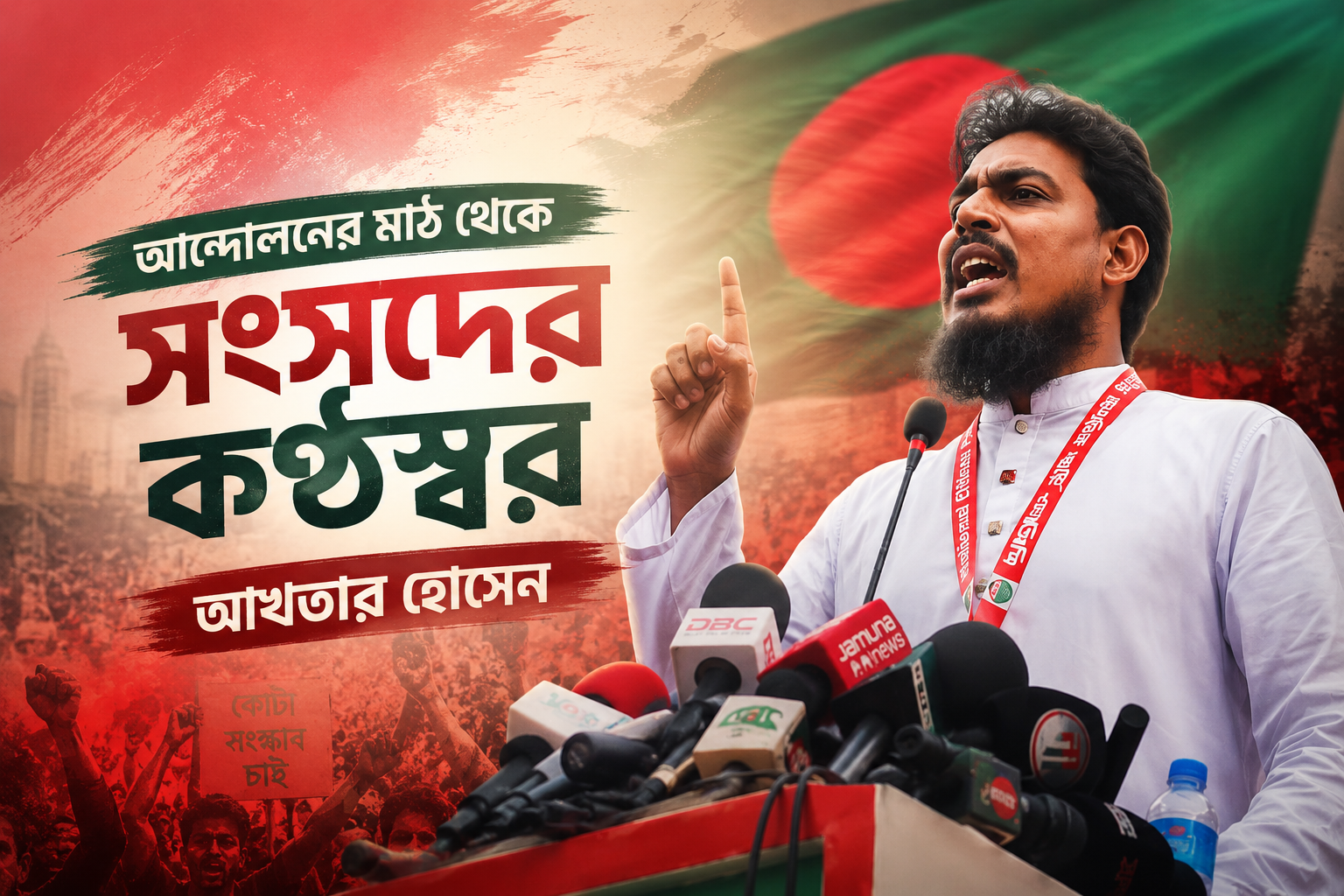
Akhtar Hossen: From the Streets of Protest to the Voice of Parliament

Published: 02:15 8 July 2026
Akhtar Hossen is one of the most talked-about young political figures in Bangladesh’s recent politics. His journey includes student politics, mass movements, demands for state reform and a place in the national parliament. From a rural background in Kaunia, Rangpur, to studying law at the University of Dhaka, protesting alone against question leaks, winning a DUCSU post, playing a role in the July movement, joining the National Citizen Committee, becoming the member secretary of the National Citizen Party and later being elected as a Member of Parliament from Rangpur-4, his journey has been eventful and full of struggle.
Akhtar Hossen’s political identity was mainly built through protest. He did not come from a major political family. Instead, he made his place in politics by speaking for students’ rights, standing against irregularities and demanding state reform. For this reason, his life story is not only the story of one politician; it is also an example of a new trend in youth politics in Bangladesh.
Akhtar Hossen at a Glance
Akhtar Hossen is the member secretary of the National Citizen Party, also known as NCP, and a Member of Parliament from Rangpur-4. In the 2026 national election, he won from the Rangpur-4 constituency. According to the state news agency BSS, he received 149,966 votes, while his nearest rival, BNP candidate Mohammad Emdadul Haque Bhorosha, received 140,564 votes.
He studied in the Department of Law at the University of Dhaka. Since his student life, he has been active on issues such as question leaks, quota reform, students’ rights and later state reform. The Daily Star described him as a graduate of the University of Dhaka’s Law Department and one of the organizers of the Anti-Discrimination Student Movement.
Childhood and Early Life
Akhtar Hossen comes from Kaunia upazila in Rangpur. According to a BSS report, his village home is in Madhupur village of Kaunia. He grew up in this rural environment.
His life began in an ordinary setting. Later, his journey from madrasa education to the University of Dhaka made him stand out to many people. In Bangladesh’s reality, moving from a madrasa background to studying law at one of the country’s top universities and then becoming a central figure in student politics is not an easy path.
Education: From Madrasa to the University of Dhaka
Akhtar Hossen completed his Dakhil from Bhayarhat Peeria Fazil Madrasa in Rangpur. Later, he completed Alim from Dhap-Satgara Baitul Mukarram Model Kamil Madrasa. After that, he got admitted to the Department of Law at the University of Dhaka. According to Campus Times, during the DUCSU election, he was a fourth-year student of the Law Department.
After entering the University of Dhaka, his political awareness became stronger. A report by The Daily Campus said that in the 2015-16 academic session, he performed well in the admission test and got the opportunity to study law at the University of Dhaka. The same report also said that allegations of question leaks in the university admission test deeply affected him.
A Lone Hunger Strike Against Question Leaks
Akhtar Hossen first came into major discussion by protesting against allegations of question leaks in the University of Dhaka admission test. In 2018, after allegations of question leaks in the ‘Gha’ unit admission test, he started a hunger strike and sit-in programme. BSS wrote that because of his firm position, the authorities were forced to cancel the controversial exam and hold it again.
According to The Daily Campus, he started the hunger strike alone in front of the Raju Memorial Sculpture. During the hunger strike, he became ill and later broke his fast after 54 hours following medical advice. After that, the university administration cancelled the previous exam and arranged a fresh test.
This incident became a major turning point in Akhtar Hossen’s political life. From that moment, he was no longer seen only as a student; he became known as a young voice who could stand against irregularities.
DUCSU Election and Victory as Social Welfare Secretary
In the 2019 DUCSU election, Akhtar Hossen contested for the post of Social Welfare Secretary from the panel of the Bangladesh General Students’ Rights Protection Council. According to Campus Times, he was elected Social Welfare Secretary with 9,190 votes. His nearest rival Azizul Haque received 8,018 votes.
BSS reported that his victory against a Chhatra League-backed candidate was considered an important event in student politics at that time.
After being elected to DUCSU, he became more active in student welfare, student rights and the democratic environment of the campus. From this period, he started moving from being a known face in student politics to becoming a figure discussed at the national level.
From Student Rights Council to Democratic Student Force
After DUCSU, Akhtar Hossen was involved with the Student Rights Council. According to The Daily Star, he later became the president of the Dhaka University unit of the Student Rights Council.
Later, he left the Student Rights Council and formed a new student organization called Democratic Student Force in 2023. According to The Daily Star, after leaving the Student Rights Council on 3 October 2023, he formed Democratic Student Force and became its convener.
Democratic Student Force created a new phase in his political thinking. Through this organization, he tried to shape the student movement as an organized force outside traditional party politics.
Role in the July Movement
The July movement of 2024 brought a major change in Bangladesh’s politics. The movement began with the demand for quota reform and later turned into a wider mass movement. Front Line Defenders described Akhtar Hossen as one of the organizers of the Anti-Discrimination Student Movement. The same source also said that he was then the convener of Democratic Student Force.
The Daily Star reported that on 17 July 2024, Akhtar Hossen, one of the organizers of the quota reform movement, was detained by police from the Raju Memorial Sculpture area at the University of Dhaka. The incident happened when the movement was becoming intense.
In an interview-style report by BSS, Akhtar Hossen said that during the July movement, people stood beside one another in difficult moments even without knowing each other. In his words, that period tied the whole nation together like a single thread.
Because of his role in the July movement, he emerged as one of the key faces of youth politics after the movement.
Role in the National Citizen Committee
After the July movement, Akhtar Hossen played an important role in the process of forming a new political and civic platform. On 8 September 2024, the National Citizen Committee was formed. According to The Daily Star, in the 55-member committee, Nasiruddin Patwary was made the convener and Akhtar Hossen was made the member secretary.
According to Bonik Barta, the goal of forming the National Citizen Committee was to advance political reform and organize the spirit of the mass uprising. The same report described Akhtar Hossen as a former DUCSU Social Welfare Secretary, a former leader of the Student Rights Council and the convener of Democratic Student Force.
This committee became an important bridge between movement-based politics and organized politics. Later, the process of forming a new political party became clearer from this platform.
Role in Forming the National Citizen Party
On 28 February 2025, the National Citizen Party, or NCP, officially started its journey. According to The Business Standard, the party was launched at Manik Mia Avenue and presented ideas such as a new constitution, structural reform and a second republic.
Al Jazeera reported that after the fall of the Sheikh Hasina government, this party was formed under the leadership of student leaders and came forward as a challenge to Bangladesh’s family-centered political culture.
Akhtar Hossen became the member secretary of the NCP. He played an important role in the party’s organizational work, candidate announcement, reform demands and election preparation. According to The Business Standard, when the NCP announced its preliminary list of candidates for 125 constituencies in December 2025, Akhtar Hossen made the announcement.
Politics and Public Engagement in Rangpur
After becoming the member secretary of the NCP, Akhtar Hossen increased his public engagement in his own area, Rangpur. According to Prothom Alo, while speaking to journalists in Rangpur, he said that there was no lack of coordination inside the NCP and that the first-line leadership of the mass uprising was leading the party.
The same report also said that he carried out public engagement activities in Rangpur city and several areas of Pirgachha and Kaunia. This shows that alongside his national-level leadership, he also tried to build direct communication with people in his own constituency.
Public Service and Local Development Vision
Akhtar Hossen has not limited himself only to political speeches; he has also been seen in some public service activities at the local level. A report in the English edition of Prothom Alo said that he distributed 1,000 blankets among cold-hit and poor people at the Kaunia Girls’ High School ground.
In terms of local development vision, he talked about implementing the Teesta Master Plan and building an economic zone between Kaunia and Pirgachha. The same report said that he expressed hope to develop Kaunia and Pirgachha as model upazilas in the future.
These points show the local side of his politics. While he speaks nationally about reform, the constitution and referendum, he also talks about development, employment and river-based economic planning in his own constituency.
First National Election and Entry into Parliament
In the 2026 national parliamentary election, Akhtar Hossen became a candidate from Rangpur-4, which includes Pirgachha and Kaunia. BSS reported that on 23 December 2025, local NCP leaders collected nomination papers on his behalf from the office of the Rangpur district returning officer.
In the 2026 election, he contested in a national election for the first time and won. According to The Business Standard, he contested as an NCP candidate with the support of an 11-party electoral alliance under the “Shapla Koli” symbol and won the seat.
His electoral victory became even more talked about because of public financial support. The Business Standard reported that he did not have much financial preparation for the election. Different people donated around Tk 27 lakh through bank accounts, bKash and Nagad. The donations ranged from Tk 10 to Tk 1 lakh.
This event added an important symbolic element to his political journey. It showed that ordinary people took part in his election campaign in a meaningful way.
Akhtar Hossen in Parliament
After being elected as a Member of Parliament, Akhtar Hossen became vocal about state reform, implementation of the referendum verdict, the July Charter and constitutional reform. According to The Daily Star, on 31 March 2026, he said in parliament that the implementation of the July Charter and the formation of a constitutional reform council depended on the political will of the ruling party.
He also raised the question of how effective the constitution was between 5 and 8 August 2024, when there was no government in the country. He raised this question in parliament.
In June 2026, while taking part in the national budget discussion, he criticized the government’s reform activities. According to The Daily Star, he warned that if the government failed to ensure good governance, democracy and institutional reform, it could lose public support.
Position on Referendum and the July Charter
A major part of Akhtar Hossen’s political speeches focuses on the implementation of the referendum verdict and the July Charter. According to The Business Standard, Akhtar Hossen said the NCP would sign the July Charter only when its implementation was ensured through an implementation order and a referendum.
At the same time, he also expressed his position on the election symbol. The report said that the NCP wants to contest elections with its own “Shapla” symbol and that every party should contest elections with its own symbol.
In another report, he said that after the people gave their verdict through a referendum, calling it unconstitutional did not match the dignity of the 13th parliament.
Life Struggle and Political Pressure
Akhtar Hossen’s journey is not only a story of success. From student life to national politics, he had to face movements, detention, political pressure and attacks. The Daily Star reported that he was detained from the University of Dhaka area during the July movement of 2024.
In 2025, there were also allegations of an attack on him during his visit to the United States. The Daily Star reported that NCP Senior Joint Member Secretary Tasnim Jara said eggs were thrown at Akhtar Hossen after he arrived in the US and he was verbally abused. Akhtar later told journalists that the attack happened because of his political identity.
Such incidents bring forward the challenges of his political life. At the same time, they show that because he came from movement-based politics, he has repeatedly faced political opposition and pressure.
His Contributions to the People
Akhtar Hossen’s contributions can be seen in several areas.
First, he took a lone stand against question leaks and raised a major question about transparency in the University of Dhaka admission test. After his hunger strike, the university administration cancelled the exam and held it again. This was an important event in favor of students’ rights and transparency in the education system.
Second, by being elected as DUCSU Social Welfare Secretary, he earned the trust of students in campus politics. His victory with 9,190 votes was a sign of support from ordinary students.
Third, he worked as an organizer in the quota reform movement and the July movement. Front Line Defenders described him as one of the organizers of the Anti-Discrimination Student Movement.
Fourth, through the National Citizen Committee and the NCP, he became involved in the process of turning movement-based politics into organized politics. According to The Daily Star, the National Citizen Committee was formed to work toward fulfilling the dream of the Anti-Discrimination Student Movement.
Fifth, after entering parliament, he spoke about reform, referendum, good governance, the judiciary and economic accountability. In the 2026 budget discussion, he also spoke about the banking sector, revenue shortage and tax pressure on middle-income and low-income people.
Political Style: Why He Stands Out
The distinctive side of Akhtar Hossen’s politics is that he did not come to national politics through traditional party structures. Instead, he came through movements, student rights activism and protest. His language is often direct, strong and reform-focused. He does not only speak about changing power; he raises questions about the state structure, constitution, political accountability and institutional reform.
The same trend is also reflected in the NCP’s declaration. At the time of its launch, the party spoke about a new constitution, a second republic and structural reform.
For this reason, Akhtar Hossen is not seen only as a young MP. He is also seen as a representative of a new political language in post-movement Bangladesh.
Future Challenges
Akhtar Hossen also has many challenges ahead. The first challenge is to turn the language of the movement into real development and policy. The people of Rangpur-4 will now expect not only speeches but also real results in roads, education, employment, agriculture, Teesta management and local development.
The second challenge is to strengthen the party organization. Since the NCP is a new party, building field-level organization, leadership coordination and political stability will not be easy. According to a Prothom Alo report, when questions were raised about coordination inside the party, Akhtar Hossen said that there was no lack of coordination in the NCP and that the party was not controlled by one single person.
The third challenge is to play an effective role in parliament. As a movement-based leader, he has popularity. But in parliament, he will have to show long-term skill in policy, law, budget, local development and national reform processes.
Conclusion
Akhtar Hossen’s life journey is a strong example of Bangladesh’s new-generation politics. From a village in Rangpur to madrasa education, from there to the Law Department of the University of Dhaka, a lone hunger strike against question leaks, victory in DUCSU, the student rights movement, Democratic Student Force, the July movement, the National Citizen Committee, the NCP and finally the national parliament—this journey has given him a distinct identity.
The biggest lesson from his life is that protest can sometimes begin with one person. If that protest is connected with truth, courage and public support, it can become the foundation of a major political journey.
Now the biggest test for Akhtar Hossen is whether he can turn the dreams of the movement into real development, good governance and public welfare. Time will answer that question. But in the discussion of youth politics in Bangladesh, his name has already become an important chapter.
Advertisement
Most Readed - Biography



- Ronaldo shares emotional message upon Messi's retirement, expressing 'utmost respect'
- Nude Trump Sculpture ‘The Orange Plague’ at the European Parliament
- Jamuna Fertilizer Factory Shuts Down Again Just Two Days After Resuming Operations
- Over 100 minutes of footage cut from Rajinikanth’s ‘Jailer 2’
- Messi bids farewell with a goal and assists, showered with love by teammates
- US troops in Okinawa face curfew and alcohol ban following murder case
- 7 Years Since Abrar Fahad's Murder: Family Frustrated by Lack of Final Justice
- Barça's Rampage in Women's El Clásico: Real Crushed 7-0
- Koel Mallick Joins BJP and Becomes Rajya Sabha Candidate
- End of a 10-Year Relationship: Pritom and Shehtaz Part Ways
- No Relief in Fish, Chicken and Egg Prices, Low-Income People Under Pressure
- Price of Low-Tier Cigarettes Raised Again; 10 Sticks Now Cost Tk 65
- Love, Resentment and ‘Write to the Address of the Sky’: The Untold Story of Rudra and Taslima
- Squad Trimmed: Six Players Dropped from Bangladesh's ASEAN Cup Team
- RAB Dissolved, SRB Begins Operations; Uniforms, Logos, and Vehicle Colors to Change
- "Jinnah's father sold fish; he was a Hindu": Fazlur Rahman's claim vs. historical records
- Bangladesh Bank to provide up to Tk 20 lakh without collateral; here is which young entrepreneurs are eligible.
- Raphinha Equals Messi's Record; Barcelona Makes History in 7-Goal Thriller
- Major blow for international students: Australia limits opportunities to bring families
- Sakib Ali: A Prominent Name in Bangladesh’s Diplomacy and Politics