Nurul Haque Nur Biography: Childhood, Education, Politics, Movements and Journey to Parliament

Published: 03:22 18 July 2026
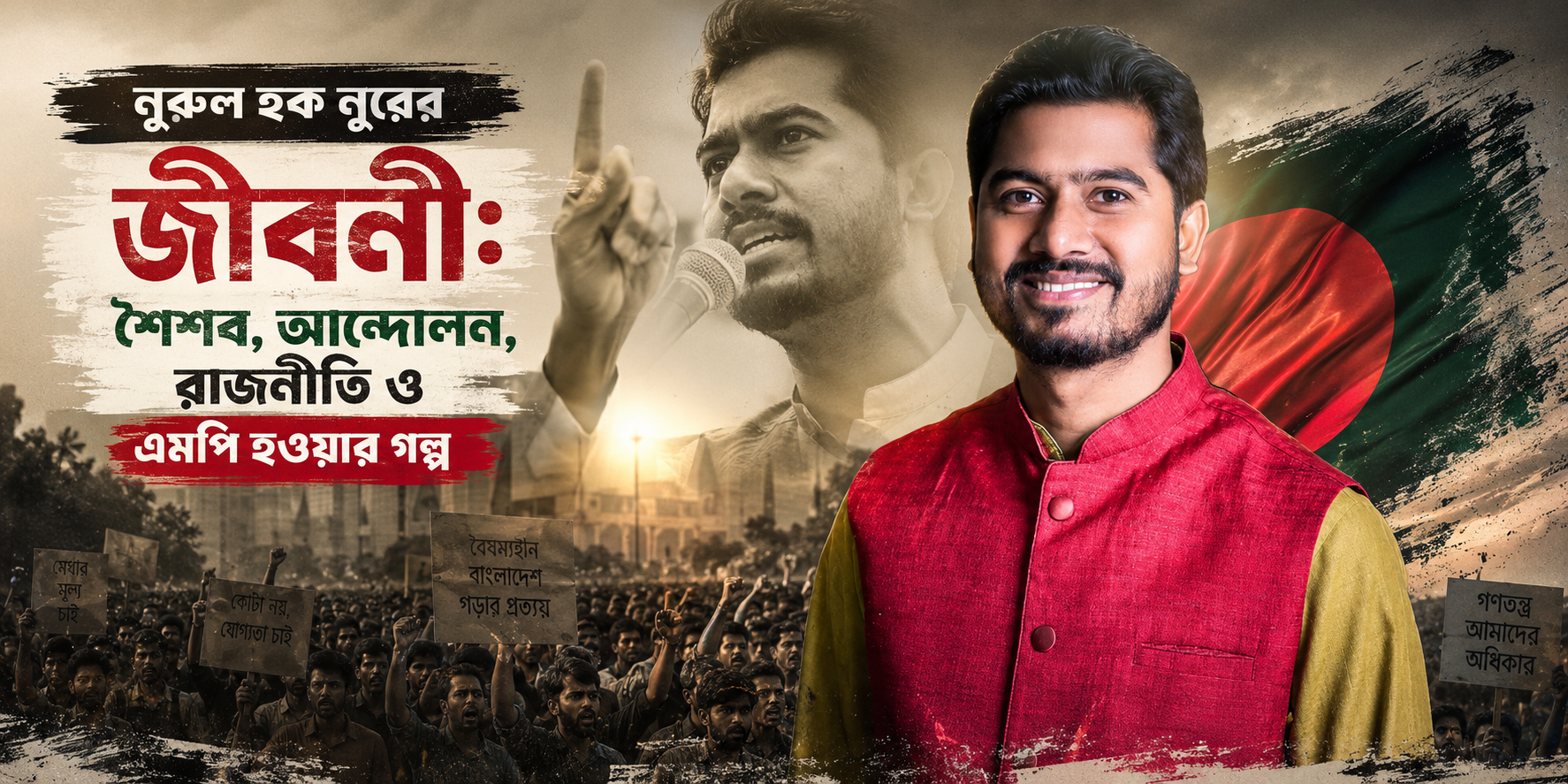
Nurul Haque Nur is one of the most discussed young political figures to emerge from Bangladesh’s recent student movements. Born into an ordinary family in a remote riverine area of Patuakhali, he rose to national prominence through the quota reform movement and later became the vice president of the Dhaka University Central Students’ Union, commonly known as DUCSU.
His rise was neither quick nor easy. His political journey has been shaped by student protests, physical attacks, arrests, court cases, imprisonment, internal party conflicts, political alliances and public controversies. At the same time, he has built a significant support base by speaking about voting rights, democracy, youth participation, employment, political reform and the rights of expatriate Bangladeshis.
To many of his supporters, he represents a new generation of leadership that emerged outside Bangladesh’s traditional political families. His critics, however, question his political consistency, leadership style, alliances and handling of internal party disagreements.
From the remote village of Char Biswas to national politics, Nurul Haque Nur’s story is one of struggle, ambition, controversy and political transformation. This biography explores his childhood, education, family life, student politics, role in the quota reform movement, DUCSU election, formation of a political party, participation in the 2024 movement, controversies, parliamentary journey and present political life.
Nurul Haque Nur at a Glance
Full Name: Mohammad Nurul Haque
Popular Names: VP Nur and MP Nur
Place of Birth: Char Biswas Union, Galachipa, Patuakhali
Education: Department of English, University of Dhaka
Political Party: Gono Odhikar Parishad
Major Political Identity: Leader of the 2018 quota reform movement and former DUCSU vice president
Constituency: Patuakhali-3, covering Galachipa and Dashmina
Wife: Maria Akter
Children: Two daughters and one son
Birth and Childhood
Nurul Haque Nur was born in Char Biswas Union under Galachipa Upazila in Patuakhali district. The area is surrounded by rivers and is geographically distant from many of the educational and economic opportunities available in major cities.
Growing up in such an environment shaped his early life. Communication facilities, access to quality education and financial opportunities were limited. Like many children from rural and coastal Bangladesh, he had to overcome geographical and economic challenges from an early age.
His father, Idris Hawlader, was a former member of the Char Biswas Union Parishad. His mother, Nilufa Begum, was a homemaker. Nur lost his mother when he was approximately two and a half years old. He grew up in a large family consisting of three brothers and five sisters, and he was the fourth child.
Losing his mother at such a young age made his childhood particularly difficult. He had to grow up without maternal care while adjusting to the responsibilities and realities of a large rural family.
His father reportedly wanted him to become a doctor. Despite financial and geographical limitations, his family continued supporting his education. His father’s expectation was that education would give Nur a stable and respected career.
However, Nur’s life eventually moved in a different direction. Instead of becoming a doctor, he became a student activist and later entered national politics.
His family witnessed years of uncertainty as he became involved in protests, political conflicts, arrests and legal cases. His father later expressed that he had never imagined seeing his son become a nationally recognised political leader.
Early Education
Nurul Haque Nur began his education in his local area. He studied at Char Biswas Janata Secondary School until the seventh grade.
To gain access to better educational opportunities, he later moved from his village to Kaliakair in Gazipur. There, he was admitted to another school in the eighth grade.
Leaving his village at a young age was an important turning point in his life. It exposed him to a different environment and required him to become independent. Moving away from his family also meant learning to adjust to unfamiliar surroundings and greater academic competition.
Nur completed his Secondary School Certificate examination in 2010. He later moved to Dhaka and studied at Uttara High School and College, completing his Higher Secondary Certificate examination in 2012.
His journey from a remote village school to an educational institution in Dhaka reflects the determination that later became visible in his political life.
University Education
After completing his higher secondary education, Nurul Haque Nur was admitted to Patuakhali Science and Technology University. He studied there for approximately one year.
He later gained admission to the Department of English at the University of Dhaka in the 2013–2014 academic session.
Admission to the University of Dhaka significantly changed his life. The university has historically played an important role in Bangladesh’s political and social movements. For Nur, the university became more than an educational institution. It became the place where his political identity developed.
During his university years, he experienced student politics, campus activism and national-level political debates. It was at the University of Dhaka that he gradually transformed from an ordinary student into a movement organiser and public figure.
Family and Personal Life
Nurul Haque Nur is married to Maria Akter, who has reportedly worked as a secondary school teacher. The couple has two daughters and one son.
Although Nur remains highly visible in the media, his family generally stays outside the political spotlight. However, his wife has appeared publicly at critical moments, particularly when he was arrested or seriously injured.
His political life has placed considerable pressure on his family. Arrests, court cases, physical attacks and uncertainty regarding his safety have created emotional and practical challenges for his wife, children, father and other relatives.
During periods of detention, his family expressed concern about his health and treatment. His wife also spoke publicly about his physical condition following his arrest during the political unrest of 2024.
Balancing family responsibilities with political leadership is an ongoing challenge for Nur. His public life often requires travelling, attending political programmes, handling party matters and responding to national developments.
Beginning of Student Politics
During the early years of his university life, Nurul Haque Nur was reportedly associated with the Bangladesh Chhatra League, the student wing of the Awami League.
However, he was not widely recognised as a major central leader of the organisation. Over time, he moved away from conventional party-based student politics and became involved in issue-based student activism.
This change was a defining moment in his political journey. Instead of continuing within the organisational structure of an established student political party, he became involved in a platform that focused on the rights and demands of ordinary students.
Supporters view this transition as evidence of his independent political thinking. Critics argue that his political positions changed according to circumstances.
Nevertheless, his public rise began after he joined a student platform that demanded reform of the quota system in government employment.
Role in the 2018 Quota Reform Movement
Nurul Haque Nur became nationally known during the 2018 quota reform movement.
At that time, he was one of the joint conveners of the Bangladesh General Students’ Rights Protection Council. The organisation demanded reform of the quota system in government jobs.
The protesters argued that the existing system provided an excessive percentage of government positions to different quota categories, limiting opportunities for general candidates. They demanded a more balanced and merit-based recruitment process.
The movement quickly spread from the University of Dhaka to other universities and educational institutions across Bangladesh. Thousands of students participated in demonstrations, road blockades and public programmes.
Nur played a visible role in organising students, announcing programmes, communicating with the media and representing the movement during discussions.
During the protests, he and other organisers faced allegations of intimidation, physical attacks and detention. These incidents increased his public visibility and helped establish him as one of the main faces of the movement.
The government later announced changes to the quota system for certain categories of government jobs. This development was considered a major victory by the protesters.
The movement transformed Nur from an ordinary university student into a nationally recognised youth leader. Many students began seeing him as a symbol of resistance against discrimination and unfairness in government recruitment.
The DUCSU Election and the Rise of “VP Nur”
In 2019, the Dhaka University Central Students’ Union election was held after a long gap. Nurul Haque Nur contested the vice president position from a panel formed by leaders of the quota reform movement.
He defeated the candidate backed by the ruling party’s student organisation and was elected vice president of DUCSU.
This victory was politically significant. It demonstrated that an independent student leader could defeat a candidate supported by a powerful and well-organised political group.
After the election, he became widely known as “VP Nur.”
However, the DUCSU election was surrounded by allegations of irregularities. Several student organisations rejected the election and demanded a fresh vote.
Nur himself raised questions about the election process. Although he had won the vice president position, he supported demands for a re-election in response to wider allegations of misconduct.
This created both praise and criticism. Supporters believed that he prioritised electoral fairness over personal victory. Critics questioned the logic of accepting the position while challenging the election process.
As DUCSU vice president, Nur spoke about student rights, campus democracy, political violence and national political issues. His tenure was marked by repeated conflicts and allegations of physical attacks against him and his supporters.
From Student Leader to National Politician
After completing his term at DUCSU, Nurul Haque Nur did not limit himself to university politics.
He and his associates worked to expand the student rights platform into broader organisations representing young people, workers and expatriates.
This expansion was intended to transform an issue-based student movement into a national political force.
On 26 October 2021, a new political party named Gono Odhikar Parishad was formally announced. Economist Reza Kibria became its convener, while Nurul Haque Nur became its member secretary.
Many of the party’s founding members had emerged from the quota reform movement and the Bangladesh Students’ Rights Council.
The party presented itself as an alternative to the country’s traditional political blocs. Its stated priorities included democracy, voting rights, anti-corruption measures, political reform, youth participation and the protection of citizens’ rights.
However, building a national party created new challenges. The organisation needed financial resources, district-level committees, policy positions, disciplined leadership and a sustainable political strategy.
Nur’s transition from activist to party leader required him to deal with responsibilities that were different from organising protests.
Did Nurul Haque Nur Change Political Parties?
Nurul Haque Nur is sometimes accused of repeatedly changing political parties. However, his political journey requires a more careful explanation.
During his early university years, he was associated with the Chhatra League. He later moved away from the organisation and joined an issue-based student rights movement.
From that movement, he helped create broader organisations and eventually became a founder of Gono Odhikar Parishad.
Therefore, his journey can be described as a transition from a traditional student organisation to an independent movement and then to a newly established political party.
Political alliances should also be distinguished from formal party changes. A party may cooperate with another political group during an election or movement without its leaders officially joining that party.
Nur’s critics consider some of his alliances inconsistent with his earlier statements. His supporters argue that political cooperation is sometimes necessary to achieve wider democratic or electoral objectives.
Internal Conflict and Division in Gono Odhikar Parishad
In 2023, Gono Odhikar Parishad experienced a serious leadership crisis.
Disagreements developed between the party’s convener, Reza Kibria, and member secretary Nurul Haque Nur. Both sides accused the other of violating organisational rules and damaging the party.
Nur’s supporters alleged that Reza Kibria was not sufficiently active in party programmes and had maintained political communication outside the organisation’s approved structure.
Reza Kibria and his supporters, on the other hand, questioned Nur’s leadership style, political contacts and decision-making process.
At one stage, both factions announced the removal of leaders from their positions. This conflict effectively divided the party into separate groups.
On 10 July 2023, the Nur-led faction organised a council in which Nurul Haque Nur was elected president and Rashed Khan was elected general secretary.
The division was a major challenge for Nur’s political reputation. Critics argued that a party founded on democratic reform should have managed its internal disagreements more transparently.
Supporters maintained that the council was necessary to create active and accountable leadership.
Role in the 2024 Movement
The 2024 student movement began with demands related to the quota system in government jobs. It was primarily led by young coordinators associated with the Anti-Discrimination Student Movement.
Therefore, it would not be accurate to describe Nurul Haque Nur as the main organiser or chief coordinator of the 2024 student movement.
However, his background as a leader of the 2018 quota reform movement gave him historical relevance to the issue.
Nur publicly supported the students’ demands and criticised the government’s handling of the situation. His party also expressed solidarity with the protesters and participated in broader anti-government programmes.
As the demonstrations expanded, the movement became connected with wider concerns, including political repression, governance, accountability and democratic rights.
Nur’s role was mainly that of an experienced former quota movement leader and opposition politician who supported the students and mobilised his party’s activists.
His supporters argue that his earlier movement helped create the political foundation for the 2024 protests. Others emphasise that the 2024 movement had its own independent student leadership and should not be credited to established political figures.
Arrest, Remand and Allegations of Torture
During the unrest of July 2024, law enforcement agencies arrested Nurul Haque Nur.
He was reportedly shown arrested in connection with a case involving the burning of Setu Bhaban. A court placed him on remand and later sent him to prison.
His wife, Maria Akter, publicly alleged that he had been taken away from his residence and that his location remained unknown for a period of time.
She also claimed that he was physically tortured during remand and that his health had seriously deteriorated.
When Nur was brought before the court, his family and supporters claimed that he was unable to walk normally.
These were allegations made by his family and political associates. Without an independent judicial finding, such claims should be reported as allegations rather than established facts.
His arrest became an important part of the political narrative surrounding the 2024 movement. Supporters presented him as one of the opposition figures who suffered during the government’s response to the protests.
Registration of Gono Odhikar Parishad
Nurul Haque Nur’s faction of Gono Odhikar Parishad later received official registration from the Election Commission.
The party was allocated the “truck” as its electoral symbol.
Registration was an important achievement because it allowed the party to participate in national elections under its own name and symbol.
For Nur, it represented the transformation of a movement-based platform into a formally recognised political organisation.
However, registration alone did not guarantee political success. The party still needed strong local committees, candidates, funding, electoral strategy and long-term public trust.
Political Attacks, Cases and Conflicts
Physical attacks and legal cases have repeatedly affected Nurul Haque Nur’s political career.
He has claimed that he was attacked several times during student and political programmes. His supporters have also accused rival groups and law enforcement agencies of targeting him.
Some of the most discussed incidents took place at the University of Dhaka and during political visits outside Dhaka.
Various cases were also filed against him over the years. These cases involved different allegations and were not all of the same nature.
It is important to remember that being named in a case does not automatically prove guilt. A person is legally considered innocent unless convicted through the judicial process.
Nur and his party have frequently described the cases against him as politically motivated. His critics argue that political leaders must still remain accountable for their statements and actions.
Major Controversies Surrounding Nurul Haque Nur
Internal Party Leadership Dispute
The division within Gono Odhikar Parishad remains one of the most important controversies of Nur’s career.
Critics accused him of centralising decision-making and failing to manage internal disagreements democratically.
His supporters argued that inactive or unaccountable leaders had to be replaced to protect the party’s future.
The conflict affected the party’s public image and raised questions about whether a new political organisation could maintain unity and institutional discipline.
Alleged Meeting with Mendi N. Safadi
A major controversy emerged over allegations that Nur had met Israeli political figure Mendi N. Safadi.
Nur denied the allegation and described it as propaganda intended to damage his political reputation.
Some of his political opponents and former associates claimed that such a meeting had taken place.
However, the matter was disputed, and no publicly established independent evidence conclusively resolved the controversy.
Therefore, the claim should be presented as an allegation accompanied by Nur’s denial.
Case Filed by a Dhaka University Student
In 2020, a Dhaka University student filed a case in which several individuals, including Nur, were named.
The principal allegation of sexual assault was not directly against Nur. The accusations involving him related to claims that he had failed to address the complaint or had assisted other accused individuals.
A tribunal later discharged Nur and several others from the charges.
When discussing this case, it is essential to mention the court’s decision and avoid presenting an unproven allegation as a confirmed fact.
Questions About Political Alliances
Nur has also faced criticism regarding his political alliances and cooperation with larger political parties.
Opponents argue that some alliances conflict with his earlier claim of building an independent alternative political force.
Supporters respond that cooperation between opposition parties is necessary during elections, democratic movements or campaigns for political reform.
The debate reflects a broader challenge for smaller parties: remaining independent while also forming alliances that increase political influence.
Journey to Parliament
Nurul Haque Nur’s political career eventually moved from street protests and university politics to parliamentary competition.
His home region in Patuakhali remained central to his political identity. Contesting from Patuakhali-3 allowed him to present himself as a representative of Galachipa and Dashmina.
His campaign focused on his background, experience in movements, political struggles and commitment to local development.
Becoming a member of Parliament represented a major transformation in his career.
As an activist, he was mainly responsible for raising demands and criticising authorities. As an elected representative, he became responsible for legislation, public accountability, constituency development and national policy.
The transition also created greater expectations. Voters would judge him not only by his speeches or sacrifices but also by his ability to deliver practical results.
Current Political Life
Nurul Haque Nur’s current political identity includes several responsibilities.
He is the president of Gono Odhikar Parishad and remains one of the party’s most recognisable leaders.
His political activities include party organisation, public meetings, parliamentary responsibilities, national political negotiations and work connected with his constituency.
Residents of Galachipa and Dashmina expect him to address local issues such as river erosion, transportation, healthcare, education, employment and infrastructure.
At the national level, supporters expect him to continue speaking about democracy, voting rights, political reform, youth participation and government accountability.
The greatest challenge for Nur is to convert movement-based popularity into effective leadership.
Political speeches can attract attention, but sustainable leadership requires policy knowledge, disciplined organisation, administrative capability and measurable results.
Political Strengths
One of Nurul Haque Nur’s greatest strengths is his identity as a leader who emerged from a public movement rather than from an established political family.
His rural background makes him relatable to many ordinary citizens, particularly young people and students from lower-middle-income families.
He communicates in direct and accessible language. He frequently responds quickly to national issues and remains active in street-based political programmes.
His experiences of attacks, arrests and imprisonment have strengthened his image among supporters as a courageous and uncompromising leader.
Nur also understands how to use media attention and public speeches to remain part of national political discussions.
His rise demonstrates that issue-based student activism can create opportunities for national political leadership.
Political Weaknesses and Challenges
Despite his achievements, Nurul Haque Nur faces several significant challenges.
The internal division within Gono Odhikar Parishad raised questions about his ability to build a stable and democratic political institution.
His critics also point to controversial statements, shifting alliances and disagreements with former colleagues.
A movement-based organisation often depends heavily on the popularity of a few leaders. For long-term success, Nur must build a party that can operate through institutions rather than personal influence alone.
He must also demonstrate consistency between his public promises and political decisions.
Now that he has entered formal electoral politics, he will increasingly be judged by his performance, policy positions and delivery of services.
His future success will depend on whether he can maintain his activist identity while becoming an effective policymaker and administrator.
Public Image and Political Legacy
Nurul Haque Nur’s public image is sharply divided.
Supporters see him as a fearless leader who challenged powerful political forces and gave voice to students and young citizens.
They highlight his role in the quota reform movement, his DUCSU victory, his physical sacrifices and his efforts to build an alternative political party.
Critics view him as inconsistent, overly confrontational or politically opportunistic. They question his alliances, organisational decisions and handling of controversies.
These contrasting views are common for political leaders who rise quickly through movements.
His final political legacy has not yet been determined. Much will depend on how he performs as a party leader and elected representative.
Conclusion
Nurul Haque Nur’s life is a remarkable story of a young man from a remote village who entered the centre of Bangladesh’s national political conversation.
His journey began in Char Biswas, where he grew up in a large family after losing his mother at an early age. He continued his education despite geographical and financial limitations, moved to Dhaka and eventually became a student at the University of Dhaka.
The 2018 quota reform movement transformed him into a national figure. His election as DUCSU vice president established the identity of “VP Nur,” while the formation of Gono Odhikar Parishad marked his entry into mainstream national politics.
His career has included achievements, sacrifices, divisions and controversies. He has faced physical attacks, arrests, legal cases and internal political conflicts. He has also been criticised for his leadership style, political alliances and changing positions.
At the same time, his rise has inspired many young people who believe that national leadership should not remain limited to traditional political families.
His journey is not complete. Becoming an elected representative has opened a new chapter in his life.
The greatest question is whether Nurul Haque Nur can transform the courage and popularity of a movement leader into the discipline and effectiveness of a national statesman.
Advertisement
Most Readed - Biography


- Ronaldo faces risk of 6-month ban for leaving national team camp
- Houthis Claim Third Attack on Riyadh Airport; Aircraft Damaged
- Cybercriminals Claim to Possess Data of 19 Million Pathao Users; $400,000 Ransom Demanded
- Ronaldo shares emotional message upon Messi's retirement, expressing 'utmost respect'
- Nude Trump Sculpture ‘The Orange Plague’ at the European Parliament
- Jamuna Fertilizer Factory Shuts Down Again Just Two Days After Resuming Operations
- Over 100 minutes of footage cut from Rajinikanth’s ‘Jailer 2’
- Messi bids farewell with a goal and assists, showered with love by teammates
- US troops in Okinawa face curfew and alcohol ban following murder case
- 7 Years Since Abrar Fahad's Murder: Family Frustrated by Lack of Final Justice
- No Relief in Fish, Chicken and Egg Prices, Low-Income People Under Pressure
- Price of Low-Tier Cigarettes Raised Again; 10 Sticks Now Cost Tk 65
- Love, Resentment and ‘Write to the Address of the Sky’: The Untold Story of Rudra and Taslima
- Squad Trimmed: Six Players Dropped from Bangladesh's ASEAN Cup Team
- RAB Dissolved, SRB Begins Operations; Uniforms, Logos, and Vehicle Colors to Change
- "Jinnah's father sold fish; he was a Hindu": Fazlur Rahman's claim vs. historical records
- Bangladesh Bank to provide up to Tk 20 lakh without collateral; here is which young entrepreneurs are eligible.
- Raphinha Equals Messi's Record; Barcelona Makes History in 7-Goal Thriller
- Major blow for international students: Australia limits opportunities to bring families
- Sakib Ali: A Prominent Name in Bangladesh’s Diplomacy and Politics