The Dignity of Physicians, the Crisis in the Health Sector, and the State’s Responsibilities
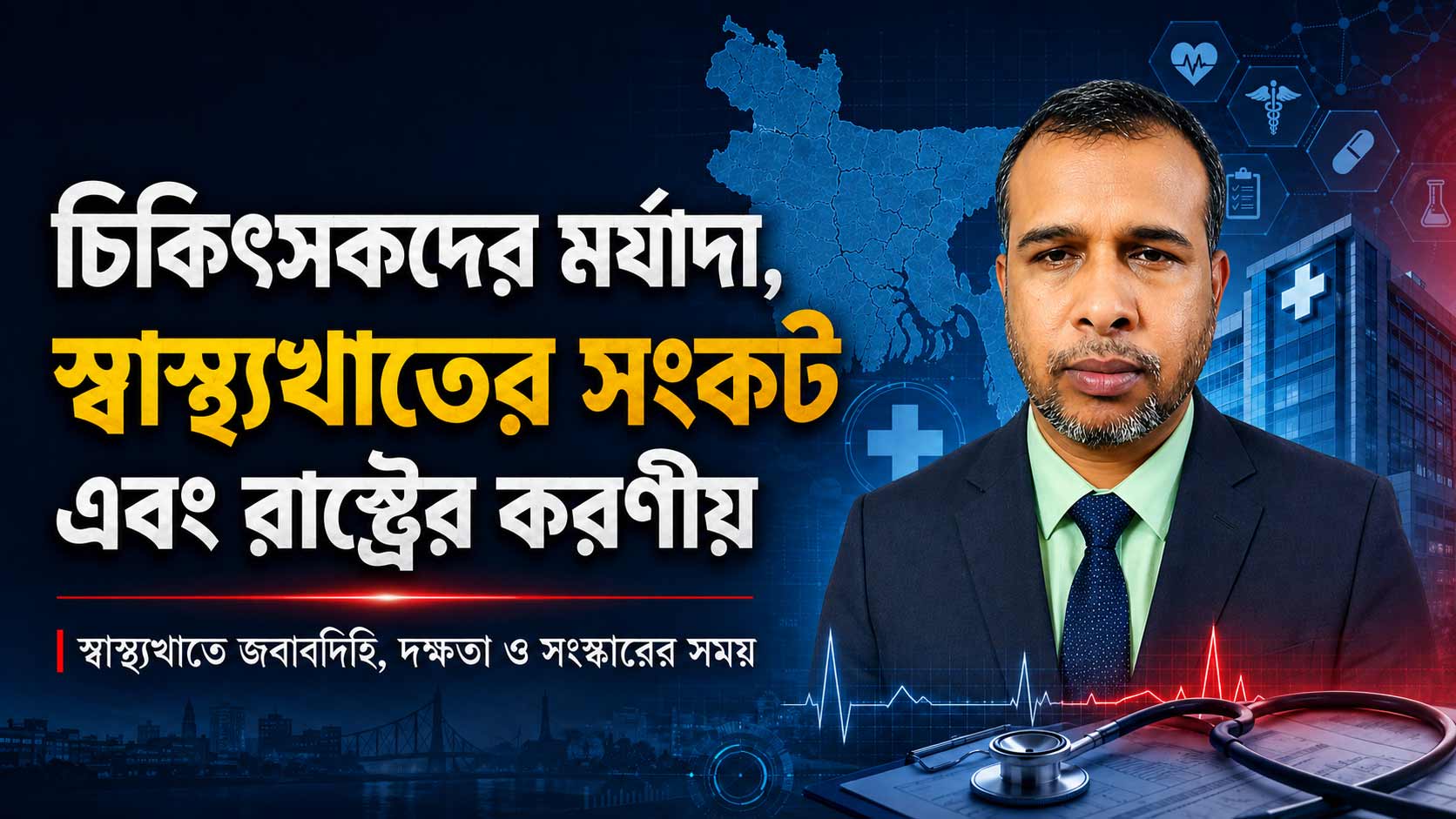
The Dignity of Physicians, the Crisis in the Health Sector, and the State’s Responsibilities
Published: 12:13 27 June 2026
In recent times, one report after another about the country’s health sector has sparked discussion in online news media and on social media. One report stated that Professor Pran Gopal Datta, a renowned physician and academic of the country, is teaching at a medical college in Tripura, India. At the same time, various claims surrounding Professor A B M Abdullah have also been widely circulated on social media. Some parts of these reports and claims are disputed. Therefore, the first responsibility should be to verify the truth of any information before spreading it.
However, beyond these reports lies a much larger reality. That reality is the long-standing structural crisis in Bangladesh’s health sector, the failure to ensure the best use of skilled physicians, and the limitations faced by ordinary people in accessing quality healthcare. Discussion centered on individuals is important, but what is even more important is understanding why such situations arise and how they can be addressed in the future.
Over the past two decades, Bangladesh has made significant progress in healthcare development. Life expectancy has increased, maternal and child mortality rates have declined, and the vaccination program has received international praise. But alongside this progress, the reality remains that the country’s public healthcare system is still far behind what is needed. Compared to the size of the population, the shortage of doctors, nurses, specialist physicians, and modern medical equipment remains a major challenge.
According to the recommendation of the World Health Organization, to build an effective healthcare system, the combined density of doctors, nurses, and midwives should be at least 44.5 per 10,000 people. Bangladesh still remains below this standard. Vacant doctor positions in government hospitals, the absence of specialist physicians at the upazila level, and shortages of doctors in rural areas have long been realities.
According to health economists, every year several hundred thousand people from Bangladesh travel to India, Thailand, Singapore, Malaysia, and other countries for advanced medical treatment. Various research and industry-related reports suggest that Bangladeshis spend around 4 to 5 billion US dollars every year on medical treatment abroad. A large portion of this huge amount of money could have remained within the country if advanced specialized healthcare, modern hospitals, and skilled human resources were more widely available.
In this context, the role of the country’s renowned physicians is extremely important. Professor Pran Gopal Datta, Professor A B M Abdullah, and other senior physicians of the country are not merely individuals; they are important assets of the country’s medical education and healthcare system. Their long experience, research, medical expertise, and ability to train new doctors should be considered part of the state’s valuable resources.
A physician may teach abroad. This is not a crime. Rather, in many cases, it reflects international recognition and the capability of Bangladesh’s medical education system. Many Bangladeshi doctors and researchers are working successfully in developed countries around the world. This does not harm the country’s image; instead, it demonstrates the strength of Bangladesh’s human resources. But the question is: how far has the country created an environment where their knowledge and experience can be properly used at home?
On the other hand, if administrative or legal action is taken against any physician, it must be done with complete transparency, based on facts, and by following due legal process. If there are allegations, there should be an investigation. If there is evidence, action should be taken. This is what the rule of law demands. But putting someone on trial through social media before allegations are proven, or spreading unsupported information and creating confusion among the public, is in no way acceptable.
At present, misinformation or partial information spreads very quickly on social media. In a sensitive sector like healthcare, such information can damage public trust. Baseless information about a physician can harm their personal and professional dignity, and it can also reduce people’s confidence in the entire healthcare system. Therefore, responsible journalism, fact-checking, and quick and clear explanations from government institutions are extremely necessary.
Another major problem in Bangladesh’s health sector is the lack of sufficient investment in research and medical education. Although public medical colleges and hospitals face enormous patient pressure, there is still a long way to go in terms of research, technological development, and building medical infrastructure of international standards. As a result, many skilled physicians seek research opportunities, teaching positions, or better working environments abroad. This is not only Bangladesh’s reality; it is also the reality of many developing countries. However, to retain skilled human resources, the state must adopt a long-term plan.
In the health sector, policy changes are often seen alongside political changes. Yet healthcare is a sector where continuity is needed most. Governments may change, but it is important to ensure that long-term plans for health policy, medical education, and human resource development do not change with every political shift.
If Bangladesh truly wants to build an advanced healthcare system, several issues must be given priority. First, a dignified working environment and safe workplaces must be ensured for physicians. Second, investment in research and medical education must be increased significantly. Third, the number of specialist physicians at the upazila and district levels must be increased, and the supply of modern medical equipment must be ensured. Fourth, the reasons why skilled physicians are moving abroad must be identified, and effective steps must be taken to address them. At the same time, transparency, accountability, and evidence-based administrative decisions must be ensured in every decision of the health sector.
The true strength of a country is not determined only by its economy or infrastructure; the quality of its healthcare system and human resources is also one of the major indicators of that strength. If controversies repeatedly arise around the country’s renowned physicians, and at the same time ordinary people are forced to go abroad for advanced treatment, then this is undoubtedly a warning sign for the state.
The health sector must be viewed as a national priority, beyond individual or political controversy. Because it takes decades to create a skilled physician, but it does not take much time to lose that physician or leave their expertise unused. Therefore, giving the highest importance to the dignity, skills, and experience of the country’s physicians and building a modern, accountable, and people-friendly healthcare system is now one of the greatest demands of the time.
— Md. Suruj Ali
Editor and Publisher
More News BD
Advertisement
- Bangladesh Women's Cricket Team Swept 3-0 by Australia
- LPG Traders Call Off Two-Day Strike; Shops to Remain Open
- Salman Khan Reveals Desire to Become a Father at 60
- Collaborators of fascism are living a lavish life abroad after looting the country's wealth: Rizvi
- Bangladesh Inspires India's Gen Z Movement: Student Leader Neha Bora
- Digital Forensic Labs to be Set Up in Eight Divisions: Home Minister
- Actress Niti Taylor makes explosive allegation: Propositioned for sexual favors in exchange for work
- Hashmatullah leaves the field after injury while batting against Bangladesh
- Bangladesh Bank Offers Special Loan Facilities and Opportunities for Small Entrepreneurs
- Dilip Ghosh Alleges Bangladesh's Involvement in Indian Protests
- Fuel for Rooppur Nuclear Power Plant Arriving in Bangladesh Today
- Cybercriminals Claim to Possess Data of 19 Million Pathao Users; $400,000 Ransom Demanded
- Messi bids farewell with a goal and assists, showered with love by teammates
- Ronaldo faces risk of 6-month ban for leaving national team camp
- Jamuna Fertilizer Factory Shuts Down Again Just Two Days After Resuming Operations
- Ronaldo shares emotional message upon Messi's retirement, expressing 'utmost respect'
- Countless Decembers will come and go, but Sheikh Hasina will not return to the country: Rashed Khan
- Three-Day Mosquito Eradication Drive Begins in Savar's Bongaon
- Price of Low-Tier Cigarettes Raised Again; 10 Sticks Now Cost Tk 65
- Hasnat Questions the Source of Salahuddin’s Wealth, Demands Transparent Accounting