"Jinnah's father sold fish; he was a Hindu": Fazlur Rahman's claim vs. historical records

Published: 11:15 18 September 2026
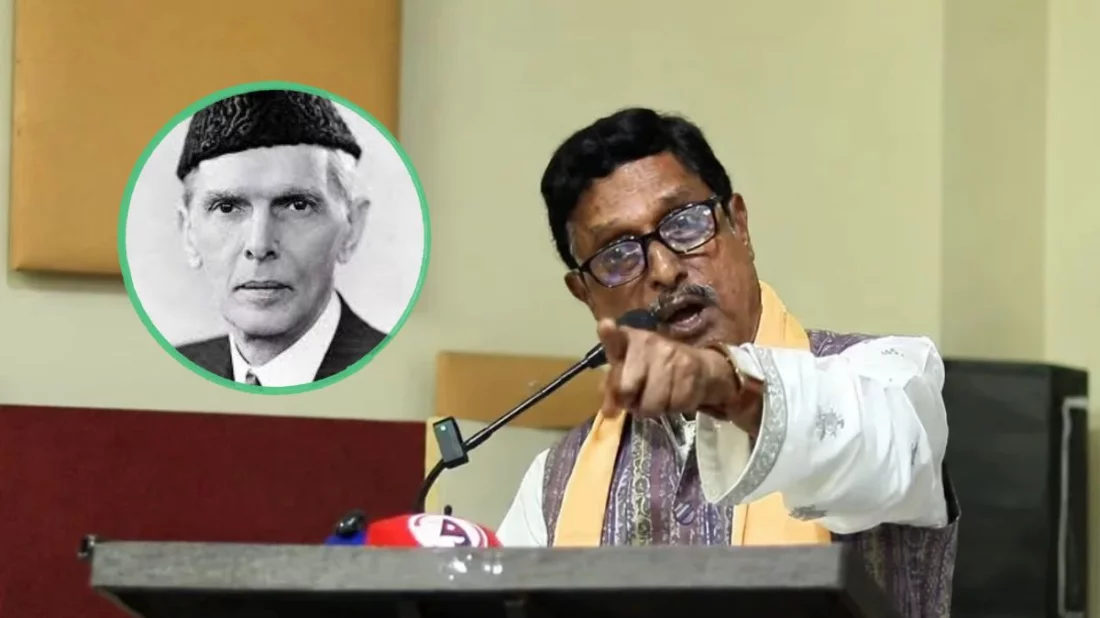
Advocate Md. Fazlur Rahman, a BNP leader and Member of Parliament for the Kishoreganj-4 constituency, has sparked a fresh controversy regarding the family background of Pakistan's founder, Muhammad Ali Jinnah. He claims that Jinnah's father sold fish, that his real name was "Jinnah Punja," and that he was a Hindu. However, established historical records and biographies reveal significant discrepancies with these claims.
Fazlur Rahman made these remarks on the evening of Thursday, September 17, while addressing a freshers' reception and cultural program organized by the Kishoreganj District Student Forum at the National Poet Kazi Nazrul Islam University. He spoke about Jinnah's family and political history, referencing the recent controversy surrounding Jinnah's portrait at the Dhaka University Central Students' Union (DUCSU) premises.
Fazlur Rahman stated that Jinnah belonged to a Khoja family from Gujarat and was involved in the fish trade. According to him, Jinnah's father sold fish, and the name "Punja" was linked to that identity. He also referred to Jinnah as a Hindu.
However, the biography published by the Pakistan government's Quaid-i-Azam Academy describes Jinnah's father, Jinnahbhai Punja, as a member of a business family. It states that the family migrated to Karachi from the Paneli area of Kathiawar, Gujarat, and that his father conducted business there. That official biography makes no mention of his father working as a fishmonger.
Other biographical sources also describe Jinnahbhai Punja simply as a businessman or merchant. Various accounts indicate that his business dealings involved commodities such as cotton, wool, and grain. Consequently, the claim that Jinnah's father was a fishmonger by profession cannot be substantiated by established biographical records.
There is also a discrepancy between Fazlur Rahman's statements and historical records regarding Jinnah's name. According to the Pakistan government's official biography, Jinnah was named Mahomedali Jinnahbhai (or Mohammad Ali Jinnahbhai) at birth, whereas "Jinnahbhai Punja" was his father's name. He later adopted the name Muhammad Ali Jinnah; consequently, official biographies do not support the claim that "Jinnah Poonja" was his actual name.
Jinnah's religious and familial background is somewhat complex. His family belonged to the Khoja community of Gujarat. Research by historian D.N. Panigrahi notes a link between Jinnah's ancestors and Hindu traditions, as well as the family's subsequent conversion to Islam and the consolidation of their Muslim identity. However, established biographies do not state that Jinnah himself was born into a Hindu family; rather, official Pakistani records describe him as the child of a Muslim business family.
Fazlur Rahman also spoke about Jinnah's political career. Historically, Jinnah was initially associated with the politics of the Indian National Congress before joining the All India Muslim League in 1913. He played a pivotal role in the 1916 Lucknow Pact, which fostered an understanding between the Congress and the Muslim League. In 1929, he presented his famous "Fourteen Points" regarding the political and constitutional rights of Muslims.
Subsequently, Jinnah emerged as the principal leader of the Muslim League and spearheaded the movement for the establishment of a separate Muslim state. Following the partition of India and the creation of Pakistan in 1947, he became the country's first Governor-General.
At the event, Fazlur Rahman also highlighted the political role played by the then-Bengal in the establishment of Pakistan. He noted that Bengalis had participated in the creation of Pakistan—a historical fact that cannot be denied. However, he observed that within a few years of Pakistan's inception, opposition began to emerge in East Bengal over various issues, including language rights.
Fazlur Rahman further remarked that the political path to Bangladesh's independence was paved through a sequence of events: the Language Movement of 1952, the 1954 elections, the anti-Ayub movement, the Six-Point Movement, the mass uprising, and the 1970 elections. These points were part of his address at the event.
However, regarding his statements on Jinnah's family background, it is important to distinguish between certain claims and the documented historical record. According to reliable biographies and official Pakistani documents, Jinnah's father, Jinnahbhai Poonja, was a businessman, and Jinnah's birth name was Muhammad Ali Jinnahbhai. Although his ancestors had ties to Hindu traditions, Jinnah himself was born into a Muslim Khoja family. Amidst the recent DUCSU controversy, renewed political and historical discourse surrounding Jinnah has brought forth various statements regarding his life and family background. When considering these statements, it is essential to distinguish between political commentary and information derived from established historical sources.
Advertisement
Most Readed - Politics

- Ronaldo shares emotional message upon Messi's retirement, expressing 'utmost respect'
- Nude Trump Sculpture ‘The Orange Plague’ at the European Parliament
- Jamuna Fertilizer Factory Shuts Down Again Just Two Days After Resuming Operations
- Over 100 minutes of footage cut from Rajinikanth’s ‘Jailer 2’
- Messi bids farewell with a goal and assists, showered with love by teammates
- US troops in Okinawa face curfew and alcohol ban following murder case
- 7 Years Since Abrar Fahad's Murder: Family Frustrated by Lack of Final Justice
- Barça's Rampage in Women's El Clásico: Real Crushed 7-0
- Koel Mallick Joins BJP and Becomes Rajya Sabha Candidate
- End of a 10-Year Relationship: Pritom and Shehtaz Part Ways
- No Relief in Fish, Chicken and Egg Prices, Low-Income People Under Pressure
- Price of Low-Tier Cigarettes Raised Again; 10 Sticks Now Cost Tk 65
- Love, Resentment and ‘Write to the Address of the Sky’: The Untold Story of Rudra and Taslima
- Squad Trimmed: Six Players Dropped from Bangladesh's ASEAN Cup Team
- RAB Dissolved, SRB Begins Operations; Uniforms, Logos, and Vehicle Colors to Change
- "Jinnah's father sold fish; he was a Hindu": Fazlur Rahman's claim vs. historical records
- Bangladesh Bank to provide up to Tk 20 lakh without collateral; here is which young entrepreneurs are eligible.
- Raphinha Equals Messi's Record; Barcelona Makes History in 7-Goal Thriller
- Sakib Ali: A Prominent Name in Bangladesh’s Diplomacy and Politics
- Major blow for international students: Australia limits opportunities to bring families