Saudi-Pakistan-Turkey ‘Mecca Agreement’, is the security equation in the Middle East changing?

Published: 02:52 8 August 2026
Amid the ongoing geopolitical tensions in the Middle East, Saudi Arabia, Pakistan and Turkey have signed a joint defense agreement. According to this agreement, known as the ‘Mecca Joint Deterrence Agreement’, an armed attack on any of the three countries will be considered a threat to the security of the three countries.
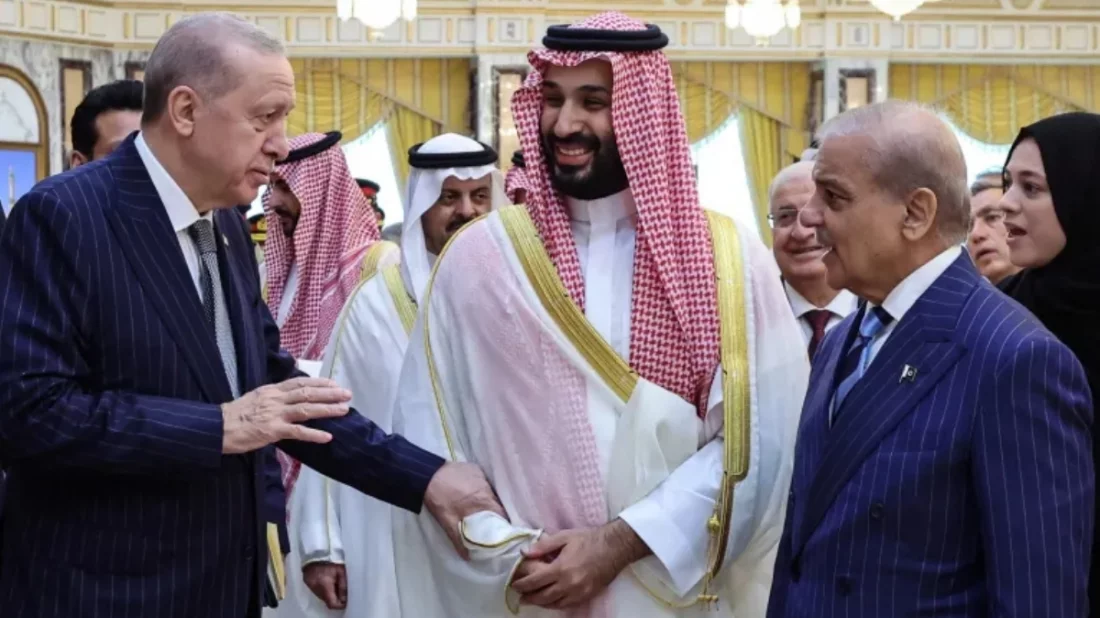
Turkish President Recep Tayyip Erdogan, Saudi Crown Prince and Prime Minister Mohammed bin Salman and Pakistani Prime Minister Shehbaz Sharif signed the agreement in Mecca, Saudi Arabia on Friday (7 August).
A statement from the Pakistani Foreign Ministry said that the agreement was based on the long-standing historical relations of the three countries, common strategic interests, defense cooperation and Islamic solidarity.
The statement further said that the agreement reflects the joint commitment of the three countries to strengthen regional and global peace, security and stability as well as build a secure and prosperous future.
A day before the signing of the agreement, Pakistani Prime Minister Shehbaz Sharif arrived in Saudi Arabia with the country's Army Chief Asim Munir. During the visit, he performed Umrah in Mecca. Later, Turkish President Erdogan also went to Saudi Arabia and met with Crown Prince Mohammed bin Salman.
Why this agreement now?
Discussions on greater security cooperation between Riyadh and Islamabad had been going on for some time. After Hamas' attack on Israel on October 7, 2023 and the subsequent Israeli military operation in Gaza, the security situation in the Middle East began to change rapidly.
Later, tensions with the United States and Israel surrounding Iran and the attacks and counterattacks in the Gulf region have further increased the need for defense coordination between the three countries, according to various international analyses.
According to the report, while Turkey and Pakistan have not been directly at the center of recent regional attacks, security concerns have increased in several Gulf countries, including Saudi Arabia, over military installations and critical infrastructure.
In addition, tensions surrounding Iran, Israel, Yemen's Houthi group and various regional armed groups have created a new security reality.
Regional tensions have brought the three countries closer
The report, citing Al Jazeera's Ankara correspondent Resul Serdar, said that the strategic situation in the Middle East has changed significantly since October 7.
Israeli military activity, the conflict surrounding Iran, the security of the Strait of Hormuz and the fear of retaliation against various countries have encouraged Turkey, Saudi Arabia and Pakistan to work more closely.
According to analysts, not a single reason, but multiple needs for security, defense, economy and regional influence have worked behind the agreement.
Initial talks were held in March
On March 19 of this year, the foreign ministers of Turkey, Pakistan and Saudi Arabia met in Riyadh on the sidelines of the Islamic Summit.
The report states that the meeting discussed a possible joint security framework and various aspects of defense cooperation.
Earlier, Pakistan and Saudi Arabia also reached a mutual defense agreement in September 2025.
Analysts believe that the new Mecca agreement has taken that cooperation to a broader framework by including Turkey.
An alternative to the US-dependent security framework?
According to Ozgur Unluhisarcikli, Managing Director of the South and Wider Europe Office of the German Marshall Fund of the United States and Regional Director for Turkey, the agreement reflects the desire for regional strategic autonomy at a time when trust in the existing security system is waning.
According to him, despite the differences in political views between Turkey, Saudi Arabia and Pakistan, they agree on some fundamental issues.
All three countries see strong state institutions, effective central governments, and territorial integrity as important foundations for regional stability.
On the other hand, they see the collapse of state structures, civil conflict, and the rise of non-state armed groups as risks of long-term instability.
How can the capabilities of the three countries be used?
One of the most important aspects of the new agreement is the opportunity to more closely utilize the military, financial, and defense-industrial capabilities of the three countries.
Turkey is one of the largest military powers in NATO and has significantly expanded its own defense industry in recent years.
On the other hand, Saudi Arabia is one of the world's most important oil exporters and a country with a large defense budget.
Pakistan has long military experience and nuclear deterrence capabilities.
Ünlühisarçıklı said the capabilities of the three countries can complement each other. In particular, Turkey's defense industry, Saudi Arabia's financial capabilities, and Pakistan's military experience and strategic deterrence could play important roles in the new security architecture.
However, he cautioned that the agreement should not be seen as a full-fledged military alliance like NATO.
Rather, it is more important as a framework for increasing strategic, military and defense-industrial cooperation between the three influential regional states.
New opportunities in Saudi defense industry
According to Murat Aslan, associate professor of international politics at Hasan Kalyoncu University in Turkey, the issue of increasing military capabilities is also important in this agreement.
Saudi Arabia has long been dependent on foreign defense equipment, especially from the United States.
However, theThe country is now emphasizing the development of its own defense industry.
In this regard, Turkey's experience with drones, missiles, armored vehicles and other defense technologies, and Pakistan's military expertise, could create new cooperation opportunities for Saudi Arabia.
Defense production from intelligence
According to the analysis of Al Jazeera's Osama bin Zayed, the agreement brings the three countries with the largest Muslim populations into a common security framework.
The agreement could also increase cooperation in preventing potential attacks, sharing intelligence, military training, energy security, defense spending and weapons production.
Some analysts believe that if it is effectively implemented, a new regional system could emerge alongside the US-based security structure that has prevailed in the Middle East for the past few decades.
What is Iran's reaction?
The report did not mention the official reaction of the Iranian government to the agreement.
However, Iranian MP Ebrahim Rezaei criticized Saudi Arabia's security policy on social media.
The gist of his statement is that it is not possible to ensure long-term security by relying solely on foreign partners.
He also called on Saudi Arabia to reconsider its own regional policy.
What is Israel saying?
The report did not mention the official reaction of Israeli Prime Minister Benjamin Netanyahu's office or the country's Foreign Ministry to the agreement.
However, the report quoted a Turkish official as saying that the agreement was defensive in nature and was not aimed at any specific country.
He added that other regional countries could also join such cooperation in the future.
Nevertheless, the concerns of Turkey, Saudi Arabia and Pakistan about Israel's military activities and regional influence in the Middle East have emerged in the statements of the countries' top leaders at various times.
Erdogan's tough stance on Israel
In early July, Turkish President Recep Tayyip Erdogan stressed the active role of regional countries in establishing peace in the Middle East at an event with Pakistani Prime Minister Shehbaz Sharif in Istanbul.
He also expressed concern about the risk of a new conflict spreading around Iran.
The Turkish president has also repeatedly criticized Israel's military operations in Gaza, Lebanon and Syria.
Pakistan has also criticized Israel's military operations in Gaza and has expressed its support for the establishment of a Palestinian state.
Saudi Arabia and the Abraham Accords
The United States has long been interested in including Saudi Arabia in the process of normalizing relations with Israel under the Abraham Accords.
However, Saudi Arabia has said that full normalization of relations with Israel is not possible without paving the way for the establishment of a viable and credible Palestinian state.
This position remains important in the larger diplomatic equation in the Middle East.
‘New Regional Security Mechanism’
According to analysis by Yasmin Farooq, the International Crisis Group’s Gulf and Arabian Peninsula project director, a common understanding is at work behind the close defense ties between Turkey, Pakistan, Saudi Arabia, and Egypt.
That is, making Middle Eastern security dependent solely on the rivalry between the United States, Israel, and Iran is risky in the long run.
The recent conflict over Iran, the threat of drone and missile attacks in the Gulf region, and concerns about the security of the Strait of Hormuz have reinforced this perception.
However, some Israeli and American analysts also see this joint security mechanism as a potential new regional anti-Israeli ring.
On the other hand, the countries involved in the agreement claim that it is not against any specific state; rather, its main purpose is to ensure mutual defense and regional stability.
The Middle East's security equation is changing
The agreement signed in Mecca comes at a time when the security architecture of the Middle East is rapidly changing.
On the one hand, tensions surrounding the United States, Israel and Iran, and on the other, regional countries' attempts to increase their own defense capabilities - between these two realities, Turkey, Saudi Arabia and Pakistan have further institutionalized their security cooperation.
The biggest question now is, will the 'Mecca Joint Deterrence Agreement' be limited to just a new framework for defense cooperation, or will it bring about a major change in the balance of the US-centered security system in the Middle East in the future.
Advertisement
Most Readed - International

- Bangladesh Women's Cricket Team Swept 3-0 by Australia
- LPG Traders Call Off Two-Day Strike; Shops to Remain Open
- Salman Khan Reveals Desire to Become a Father at 60
- Collaborators of fascism are living a lavish life abroad after looting the country's wealth: Rizvi
- Bangladesh Inspires India's Gen Z Movement: Student Leader Neha Bora
- Digital Forensic Labs to be Set Up in Eight Divisions: Home Minister
- Actress Niti Taylor makes explosive allegation: Propositioned for sexual favors in exchange for work
- Hashmatullah leaves the field after injury while batting against Bangladesh
- Bangladesh Bank Offers Special Loan Facilities and Opportunities for Small Entrepreneurs
- Dilip Ghosh Alleges Bangladesh's Involvement in Indian Protests
- Fuel for Rooppur Nuclear Power Plant Arriving in Bangladesh Today
- Cybercriminals Claim to Possess Data of 19 Million Pathao Users; $400,000 Ransom Demanded
- Messi bids farewell with a goal and assists, showered with love by teammates
- Ronaldo faces risk of 6-month ban for leaving national team camp
- Jamuna Fertilizer Factory Shuts Down Again Just Two Days After Resuming Operations
- Ronaldo shares emotional message upon Messi's retirement, expressing 'utmost respect'
- Countless Decembers will come and go, but Sheikh Hasina will not return to the country: Rashed Khan
- Three-Day Mosquito Eradication Drive Begins in Savar's Bongaon
- Price of Low-Tier Cigarettes Raised Again; 10 Sticks Now Cost Tk 65
- Hasnat Questions the Source of Salahuddin’s Wealth, Demands Transparent Accounting