The Story of Hussain Muhammad Ershad’s Rule, Controversy Over Authoritarianism, and Fall from Power

Published: 07:02 1 September 2026
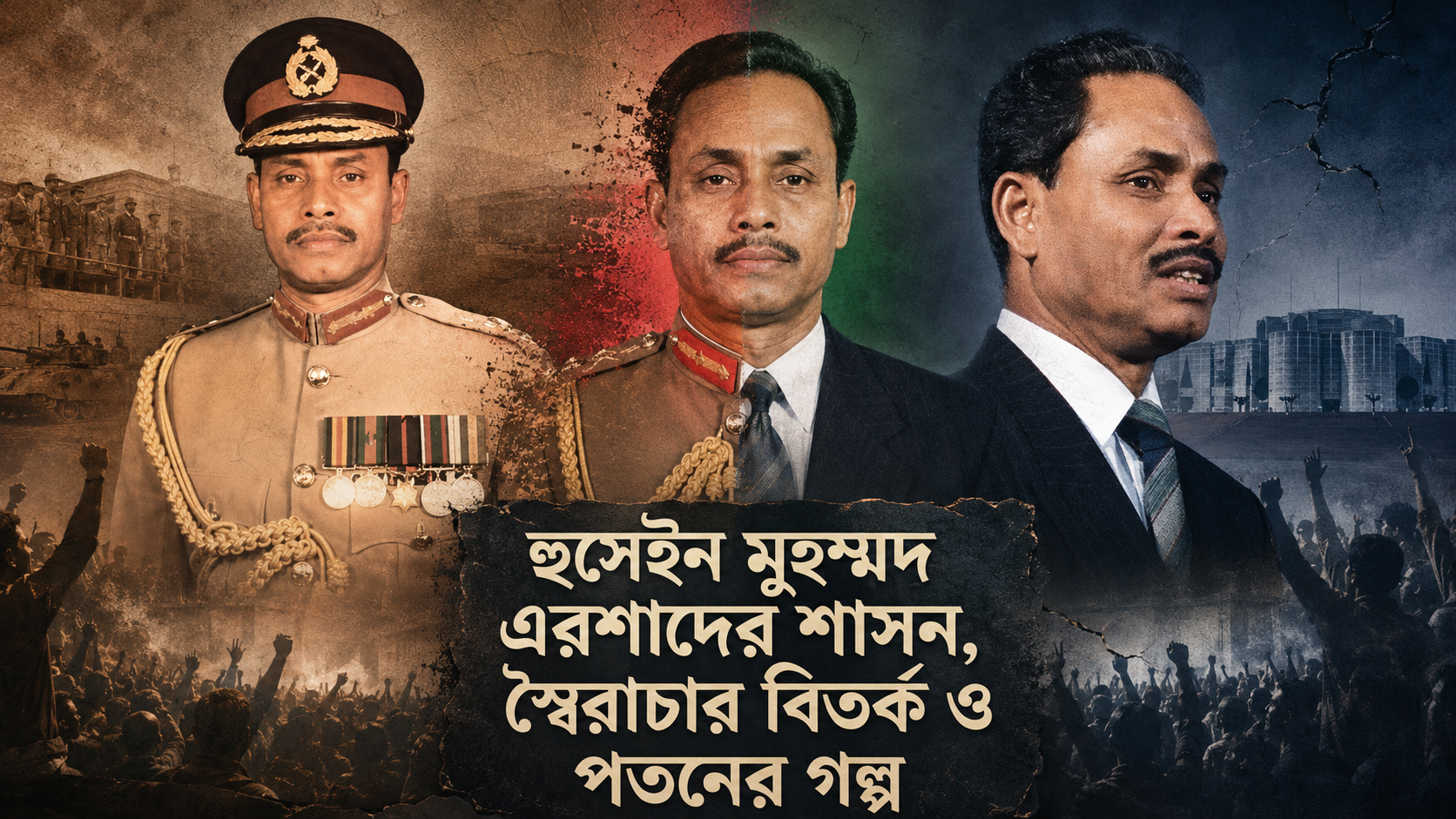
Hussain Muhammad Ershad was one of the most influential and controversial political figures in the history of Bangladesh. A career military officer who rose to become the Chief of Army Staff, Ershad seized state power in 1982 through a bloodless military coup and later became President of Bangladesh.
He remained at the center of the country's political system for almost nine years. His rule was marked by military governance, administrative reforms, the introduction of the upazila system, controversial elections, constitutional changes and strong opposition movements.
Ershad eventually resigned in December 1990 following a mass uprising against his government. However, his political career did not end with his fall from power. He founded the Jatiya Party and remained an important figure in Bangladesh's parliamentary politics for decades.
His legacy remains deeply divided. Supporters point to administrative decentralization, infrastructure development and rural development initiatives during his rule. Critics remember him primarily as a military ruler whose government restricted democratic politics and faced allegations of electoral irregularities and repression.
Who Was Hussain Muhammad Ershad?
Hussain Muhammad Ershad was a Bangladeshi military officer and politician who served as the country's President from 1983 until 1990.
He became Chief of Army Staff before taking control of the government on March 24, 1982. After initially ruling through martial law, he assumed the presidency on December 11, 1983. He later founded the Jatiya Party in 1986 and used the party as the principal political platform supporting his government.
Ershad remained politically active after leaving office and was repeatedly elected to parliament from constituencies in Rangpur.
Early Life and Birth
Hussain Muhammad Ershad was born on February 1, 1930, in Dinhata, Cooch Behar, in British India.
His family later moved to what became East Pakistan following the Partition of British India.
He grew up in the Rangpur region and eventually pursued higher education before entering military service.
His early life did not indicate that he would eventually become one of the most powerful political figures in Bangladesh. His rise was largely connected to his military career and the political instability of Bangladesh during the late 1970s and early 1980s.
Education
Ershad studied at Carmichael College in Rangpur before entering military service.
He subsequently received professional military training and attended institutions associated with military education and command training.
His military education helped him build a long career within the armed forces and eventually rise to the highest level of Bangladesh's military hierarchy.
Ershad's Military Career
Ershad joined the military and served in the Pakistan Army before Bangladesh's independence.
After the Liberation War of 1971, he returned to Bangladesh and continued his career in the newly formed Bangladesh Army.
He rose rapidly through the ranks and eventually became one of the most senior officers in the country's military establishment.
His appointments included important command and staff positions, and he eventually became Chief of Army Staff.
His position as army chief placed him at the center of Bangladesh's political and military power structure.
Becoming Chief of Army Staff
Ershad became Chief of Army Staff in 1978.
At the time, Bangladesh was experiencing considerable political uncertainty following the assassination of President Sheikh Mujibur Rahman in 1975 and the subsequent political and military changes.
As army chief, Ershad gradually became one of the country's most powerful figures.
His influence increased further following the assassination of President Ziaur Rahman in 1981.
The 1982 Military Coup
The defining moment of Ershad's career came on March 24, 1982.
As Chief of Army Staff, he took control of the government of President Abdus Sattar in a bloodless military coup. He suspended the Constitution, dissolved parliament and imposed martial law.
Ershad became the Chief Martial Law Administrator.
The military takeover marked the beginning of a new era of military-backed rule in Bangladesh.
Ershad justified his intervention by referring to political instability, administrative problems and the need to restore discipline and order.
However, opposition political forces regarded the takeover as an unconstitutional seizure of power.
Rule Under Martial Law
After taking power, Ershad initially did not immediately become President.
Justice A. F. M. Ahsanuddin Chowdhury was appointed President, but the actual authority remained with Ershad as Chief Martial Law Administrator.
According to Banglapedia, Ershad ruled the country through martial law regulations, orders and ordinances before eventually taking over the presidency himself.
This arrangement allowed Ershad to gradually consolidate political and administrative power.
Ershad Becomes President
On December 11, 1983, Ershad assumed the presidency.
His transition from army chief and Chief Martial Law Administrator to President marked another major stage in his consolidation of power.
Although civilian institutions continued to exist, the political environment remained heavily influenced by military authority.
Ershad later sought to give his government a stronger political and electoral foundation.
The Introduction of the Upazila System
One of the most important administrative reforms associated with Ershad was the introduction of the upazila system.
The system was introduced in 1984 as part of an effort to decentralize government administration and development activities.
The first upazila parishad elections were held in 1985.
Supporters of Ershad have often highlighted the upazila system as one of his government's most significant achievements.
The system was designed to bring administration and development planning closer to rural communities.
However, critics argued that decentralization also helped Ershad strengthen his political influence at the local level.
Economic and Infrastructure Development
During Ershad's rule, the government undertook a number of infrastructure and socioeconomic development programs.
Roads, bridges, rural infrastructure, administrative institutions and development projects expanded in different parts of the country.
His government also pursued policies involving the restructuring and privatization of some nationalized industries.
Supporters argue that these initiatives contributed to rural development and administrative modernization.
Critics, however, maintained that development programs could not compensate for the democratic shortcomings of military rule.
The Referendum of 1985
In an effort to strengthen the legitimacy of his government, Ershad held a national referendum in 1985.
The official result showed overwhelming support for his leadership.
However, opposition groups questioned the credibility of the referendum and alleged irregularities.
The referendum was part of a broader effort by Ershad to transition from direct military rule toward an electoral political system.
Founding the Jatiya Party
A major turning point in Ershad's political career came in 1986 when he founded the Jatiya Party.
The party was established on January 1, 1986, and became the main political organization supporting Ershad.
The formation of Jatiya Party allowed Ershad to enter electoral politics while maintaining strong control over the political system.
The party later became one of Bangladesh's major political parties.
The 1986 Parliamentary Election
Parliamentary elections were held on May 7, 1986.
Ershad's Jatiya Party won 153 of the 300 directly elected seats.
The election was highly controversial because the Bangladesh Nationalist Party boycotted it, while the Awami League participated.
Observers and opposition groups raised concerns about the fairness and credibility of the election. British observers famously criticized the election as deeply damaging to democratic credibility.
Despite the controversy, the election provided Ershad with an elected parliament and a stronger political foundation.
The 1986 Presidential Election
Later in 1986, Ershad contested the presidential election.
The election was held on October 15, 1986, and Ershad won with a reported 84.1 percent of the vote.
However, major opposition candidates and parties did not participate, and the election was accompanied by allegations of irregularities.
As a result, although Ershad formally became an elected President, the legitimacy of the electoral process remained a major subject of political controversy.
Lifting Martial Law
After consolidating his political position through elections, Ershad moved toward formally ending martial law.
In November 1986, parliament passed the Seventh Amendment to the Constitution, which among other things provided legal protection for actions taken under martial law.
Martial law was subsequently withdrawn.
This represented Ershad's formal transition from direct military administration to constitutional government, although opposition parties continued to challenge the legitimacy of his political system.
The Seventh Amendment Controversy
The Seventh Amendment became controversial because it retrospectively validated actions and laws taken under Ershad's martial-law regime.
The amendment effectively provided constitutional protection for actions carried out between the 1982 takeover and the restoration of constitutional government.
This became part of the broader debate over whether Ershad's rule could be legally and democratically legitimized after the military takeover.
The 1988 General Election
Another controversial election took place on March 3, 1988.
Most major opposition parties, including the Awami League and BNP, boycotted the election.
Ershad's Jatiya Party won 251 of the 300 seats.
The boycott meant that the election was conducted without participation from several of the country's major political forces.
The result further intensified criticism of Ershad's government.
Islam as the State Religion
One of the most significant constitutional changes during Ershad's rule came in 1988.
Through the Eighth Amendment to the Constitution, Islam was declared the state religion of Bangladesh.
The decision became a major political and constitutional issue.
Supporters viewed the move as reflecting the religious identity of the country's majority population, while critics argued that it represented a departure from the secular principles associated with the original constitutional framework.
The issue remains an important part of discussions about Ershad's political legacy.
Growing Opposition to Ershad
By the late 1980s, opposition to Ershad had become increasingly organized.
The Awami League, BNP and various left-wing parties conducted protests and political campaigns against his government.
Students also played a major role in the anti-Ershad movement.
Strikes, demonstrations, marches and political protests became increasingly frequent.
The growing alliance among opposition groups gradually created a nationwide movement demanding Ershad's resignation and the restoration of democracy.
The Anti-Ershad Movement
The movement against Ershad reached a critical stage between 1987 and 1990.
Political parties, student organizations, professional groups and civil society became increasingly involved.
Universities became important centers of resistance.
The government's attempts to control political protests further increased public dissatisfaction.
The opposition movement eventually developed into a broad-based mass uprising.
The 1990 Mass Uprising
The decisive moment came in 1990.
The anti-Ershad movement intensified across the country, with large demonstrations in Dhaka and other major cities.
Opposition political alliances became stronger, while student protests continued to put pressure on the government.
As the movement expanded, Ershad's political support weakened.
On December 6, 1990, he resigned from the presidency.
His resignation brought an end to nearly nine years of rule.
Banglapedia records December 6, 1990, as the date when Ershad was finally forced to step down following the sustained opposition movement.
Why Was Ershad Called an Authoritarian Ruler?
Ershad is frequently described as an authoritarian ruler because he initially came to power through a military takeover rather than through a democratic election.
His government imposed martial law, restricted political activity and faced repeated criticism over the treatment of opposition forces.
The elections held under his government were also controversial, particularly because major opposition parties boycotted some of them and allegations of irregularities were raised.
For these reasons, many historians and political analysts characterize his period in power as a military-backed authoritarian regime.
At the same time, supporters have emphasized his administrative reforms, decentralization policies and development initiatives.
Ershad's Fall From Power
Ershad's fall was not caused by a single event.
Several factors contributed to the collapse of his government.
These included years of opposition political activity, student movements, public dissatisfaction, controversial elections and growing demands for democratic restoration.
The unity among major opposition forces became particularly important.
By late 1990, the political pressure became impossible for Ershad's government to withstand.
His resignation marked a major turning point in Bangladesh's democratic history.
Arrest After Leaving Office
Ershad's political problems did not end after his resignation.
He was arrested in 1991 and spent years dealing with legal cases.
The government that came to power after the fall of Ershad filed several cases against him, including corruption-related charges.
He was convicted in some cases, although his legal battles continued for years.
Banglapedia notes that he was kept in prison after his arrest and later released on bail in January 1997 after years of confinement.
Ershad's Remarkable Political Comeback
Despite his imprisonment and legal troubles, Ershad demonstrated significant political resilience.
In the 1991 parliamentary election, he contested from five constituencies in Rangpur while in prison and won all five.
This demonstrated that his political influence, particularly in northern Bangladesh, remained strong even after his fall from power.
He again won five constituencies in the 1996 election.
His continued electoral success made him an unusual example of a former military ruler maintaining a strong political base after leaving office.
Ershad and the Jatiya Party After 1990
After the fall of his government, Jatiya Party continued to play an important role in Bangladesh's parliamentary politics.
The party sometimes supported the Awami League and at other times maintained an opposition position.
Ershad himself remained the central figure of the party for many years.
His political strategy after 1990 focused less on returning to direct executive power and more on maintaining influence through parliamentary politics and alliances.
Ershad as a Political Kingmaker
Because of Jatiya Party's parliamentary strength, Ershad often became an important figure in Bangladesh's coalition politics.
Neither the Awami League nor BNP could always ignore the political influence of Jatiya Party.
As a result, Ershad was sometimes described as a kingmaker in parliamentary politics.
His ability to negotiate alliances made him an important political actor even after he was no longer President.
Personal Life
Ershad's personal life was also frequently discussed in Bangladesh's media.
His marriages, family relationships and private life attracted considerable public attention.
His wife, Rowshan Ershad, became a prominent political figure in her own right and played an important role in Jatiya Party politics.
Ershad also had children, some of whom later became involved in political and public life.
Ershad as a Poet and Writer
Ershad also had an interest in literature and poetry.
He wrote poems and published literary works during and after his political career.
His literary activities attracted attention because of his position as a head of state and later as a major political leader.
Supporters regarded his literary interests as evidence of another side of his personality, while critics sometimes viewed his cultural activities through the lens of his political image.
Awards and Recognition
During his political career, Ershad received various national and international recognitions.
Some of the awards and honors associated with him related to population, environmental and social development initiatives.
However, his international reputation remained mixed because of the controversy surrounding his military rule and democratic credentials.
Ershad's Relationship With the Military
The military remained central to Ershad's political identity throughout his life.
His rise to power was directly connected with his position as army chief, and his government initially operated under martial law.
Even after formally moving toward electoral politics, the military's historical role in his rise remained an important part of political discussions surrounding his rule.
His career therefore represents one of the clearest examples of military influence on Bangladesh's political system in the post-independence period.
Ershad's Political Legacy
Ershad's legacy is complicated and remains a subject of debate.
His supporters point to administrative decentralization, the upazila system, infrastructure development and rural development.
His critics emphasize the military takeover, restrictions on democratic politics, controversial elections and the suppression of opposition movements.
Both aspects are important for understanding his historical role.
It would therefore be difficult to describe Ershad solely as either a reformer or a dictator without considering the full context of his rule.
The Upazila System as His Major Legacy
Among Ershad's most lasting institutional contributions was the upazila system.
The system brought a greater degree of administrative and development responsibility to local areas.
Although its political motivations were debated, the upazila structure became an enduring part of Bangladesh's local government system.
For this reason, even critics of Ershad's political rule acknowledge that his decentralization program had a lasting impact on the country's administrative structure.
Controversial Elections Under Ershad
Elections remain one of the most controversial aspects of Ershad's rule.
The 1986 parliamentary election was boycotted by BNP, while the 1988 election was boycotted by most major opposition parties.
The presidential election of 1986 was also controversial because major opposition candidates did not participate.
These events created persistent questions about the democratic legitimacy of Ershad's government.
Ershad's Death
Hussain Muhammad Ershad died on July 14, 2019, at the Combined Military Hospital in Dhaka.
He was 89 years old.
His death marked the end of the life of one of the most controversial and enduring political figures in Bangladesh.
However, his political legacy continued through the Jatiya Party and through ongoing debates about his nine years in power.
The Historical Importance of Ershad
Ershad occupies a unique place in Bangladesh's political history.
He was a military officer who became army chief, seized power, ruled under martial law, became President through a controversial electoral process, founded a political party, faced a mass uprising and eventually returned to parliamentary politics.
Few Bangladeshi politicians have experienced such a dramatic transformation in political status.
His career therefore provides an important lens through which to understand Bangladesh's transition from military-backed government toward parliamentary democracy.
Was Ershad a Dictator or a Reformer?
The answer depends heavily on which part of his political career is being examined.
From the perspective of how he came to power and governed the country, Ershad's rule is widely characterized as authoritarian and military-backed.
From the perspective of administrative reforms and development, his government introduced several measures that continued to influence Bangladesh after his departure.
The most balanced historical assessment is therefore to recognize both realities.
His government implemented significant administrative changes while simultaneously facing serious criticism over democratic rights and political legitimacy.
Ershad's Place in Bangladesh's Political History
Hussain Muhammad Ershad remains an important figure in understanding modern Bangladesh.
His nine-year rule changed the country's political and administrative structures in significant ways.
His fall in 1990 also demonstrated the strength of mass political movements and the demand for democratic governance.
Yet his post-presidential political career showed that even a leader who had been removed through a mass uprising could maintain a significant electoral base and continue to influence national politics.
Conclusion
Hussain Muhammad Ershad's life was a remarkable combination of military ambition, political power, administrative reform, controversy and political resilience.
He rose through the ranks of the military to become Chief of Army Staff and then seized state power on March 24, 1982.
After ruling under martial law, he became President in 1983 and later established the Jatiya Party in 1986.
His government introduced the upazila system, pursued decentralization and implemented various development programs. At the same time, his rule was heavily criticized because of military intervention in politics, restrictions on democratic activity and controversial elections.
The opposition movement against him eventually became a nationwide mass uprising. On December 6, 1990, Ershad resigned from the presidency, ending nearly nine years of rule.
Yet his political career continued. He faced imprisonment and corruption cases but later returned to electoral politics and repeatedly won parliamentary seats.
Through the Jatiya Party, he remained an important figure in Bangladesh's political system until his death in 2019.
Ershad's historical legacy remains contested. To some, he was an authoritarian military ruler who interrupted Bangladesh's democratic development. To others, he was an effective administrator whose decentralization and development policies had lasting effects.
Whatever the interpretation, Hussain Muhammad Ershad remains one of the most consequential political figures in Bangladesh's post-independence history. His rise, rule, fall and subsequent political comeback form a remarkable chapter in the country's journey through military government, mass movements and parliamentary democracy.
Advertisement
Most Readed - Biography




- State Minister Spends Night at Secretariat to Prevent Question Paper Leaks; 300,000 Candidates to Take Exam Today
- Mirza Abbas returns home from Malaysia after nearly a month of medical treatment
- 8 Pieces of Luggage, Including Cricketers' Passports and iPhones, Go Missing; Police Investigate
- US Considers Using ‘Mother of All Bombs’ in Iran; Tensions Rise
- Electricity from Rooppur to Join National Grid in November; Second Unit Targeted for June
- Bangladesh Women's Cricket Team Swept 3-0 by Australia
- LPG Traders Call Off Two-Day Strike; Shops to Remain Open
- Salman Khan Reveals Desire to Become a Father at 60
- Collaborators of fascism are living a lavish life abroad after looting the country's wealth: Rizvi
- Bangladesh Inspires India's Gen Z Movement: Student Leader Neha Bora
- Fuel for Rooppur Nuclear Power Plant Arriving in Bangladesh Today
- Cybercriminals Claim to Possess Data of 19 Million Pathao Users; $400,000 Ransom Demanded
- Jamuna Fertilizer Factory Shuts Down Again Just Two Days After Resuming Operations
- Messi bids farewell with a goal and assists, showered with love by teammates
- Ronaldo faces risk of 6-month ban for leaving national team camp
- Ronaldo shares emotional message upon Messi's retirement, expressing 'utmost respect'
- Countless Decembers will come and go, but Sheikh Hasina will not return to the country: Rashed Khan
- Hasnat Questions the Source of Salahuddin’s Wealth, Demands Transparent Accounting
- Three-Day Mosquito Eradication Drive Begins in Savar's Bongaon
- Price of Low-Tier Cigarettes Raised Again; 10 Sticks Now Cost Tk 65