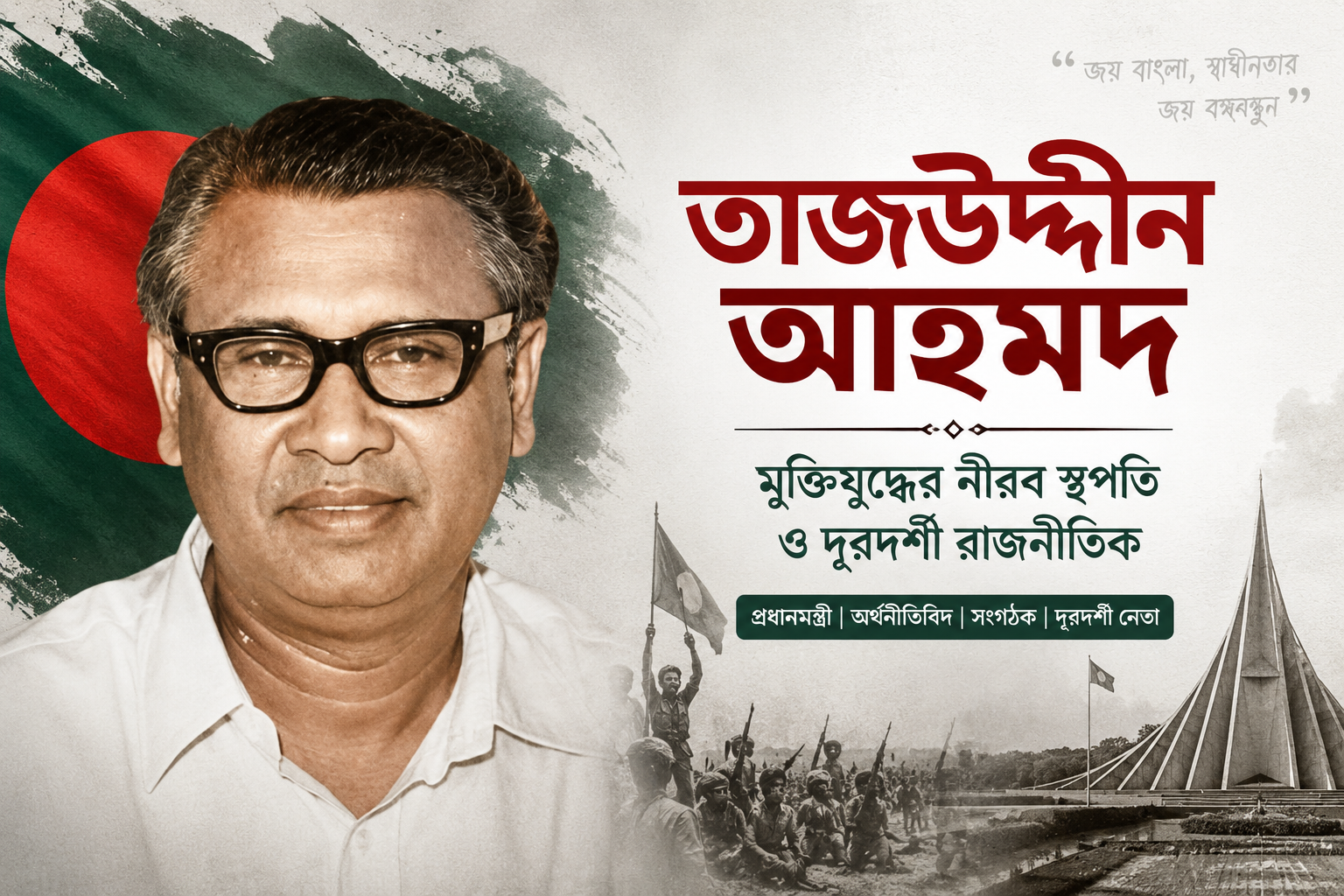
Tajuddin Ahmed Biography: Silent Architect of the Liberation War and Visionary Politician

Published: 11:51 23 July 2026
Introduction: The Beacon of History and Silent Unsung Hero
When reviewing the history of Bangladesh's liberation struggle, among the immortal figures whose names shine in golden letters, Bangataj Tajuddin Ahmad stands as one of the most indispensable personalities. He was not merely a conventional politician; he was simultaneously a visionary social thinker, an efficient administrator, a deeply intellectual strategist, and a selfless patriot. He was the primary driving force behind the arduous intellectual and organizational groundwork for establishing an independent Bangladesh.
During the bloody and critical days of 1971, when the supreme commander of the Bengali nation, Bangabandhu Sheikh Mujibur Rahman, was imprisoned by the Pakistani regime, Tajuddin Ahmad emerged as a beacon of light in the nation's darkest hour. He courageously formed the provisional "Mujibnagar Government" and, amidst extremely hostile political, international, and military challenges, provided steadfast leadership to guide Bangladesh through nine months of bloody war toward the shore of victory.
On the political stage, Tajuddin Ahmad never sought personal publicity, power, or fame. He preferred working quietly behind the scenes. For this reason, historians often describe him as the "silent architect" or the "symbol of unpretentious politics." This article presents a detailed and comprehensive analysis of Bangataj Tajuddin Ahmad’s birth, childhood, political development, role in the Language Movement, the Six-Point Demand, his pivotal leadership in the 1971 Liberation War, his post-independence contributions to nation-building, and his tragic martyrdom following the assassination of the Father of the Nation and his family.
Lineage, Birth, and Family Background
Tajuddin Ahmad was born on July 23, 1925, into a respectable Muslim family in the historic village of Dordoria, situated along the banks of the Shitalakshya River in Kapasia Upazila of Dhaka District (present-day Gazipur District).
His father was Moulvi Mohammad Yasin Khan and his mother was Meherunnesa Khanam. Moulvi Yasin Khan was a deeply religious, honest, and Sufi-leaning individual who was highly respected in the area as an advocate for education and a community arbiter. His mother, Meherunnesa Khanam, was a calm and affectionate homemaker whose moral values left a lasting imprint on Tajuddin's upbringing.
Among four brothers and four sisters, Tajuddin Ahmad was the fourth child of his parents. Growing up in a rural environment surrounded by rivers and observing the day-to-day struggles of ordinary people instilled in him a deep empathy and affection for the working class from an early age.
Education and Outstanding Intellectual Brilliance
Tajuddin Ahmad began his education at his village primary school and later attended the local Kainat Minor School. Possessing a remarkably sharp intellect, Tajuddin demonstrated exceptional academic talent right from his childhood.
Secondary and Higher Secondary Education
He later enrolled at St. Gregory's High School in Dhaka. From here, in 1944, he passed the Matriculation (now SSC) examination, securing the 12th position on the merit list in the Dhaka division. Subsequently, he was admitted to the renowned Dhaka College. In 1948, he appeared for the Intermediate (now HSC) examination from Dhaka College and achieved the 4th rank on the merit list across all of East Pakistan.
Dhaka University and Legal Studies
For higher education, he joined the Department of Economics at the University of Dhaka, earning his Bachelor of Arts (Honours) degree in Economics in 1953. Despite his intense political engagement and frequent imprisonments, he did not abandon his academic pursuits. Later, he studied law and obtained his Bachelor of Laws (LL.B.) degree to qualify as an advocate.
Political Induction and Organizational Growth
From his student days, Tajuddin Ahmad was drawn toward social service and politics. He firmly believed that politics was not a mere struggle for power, but the primary instrument for achieving the freedom and rights of the masses.
All India Muslim Students Federation and Founding of Chhatra League
In 1943, he joined the All India Muslim Students Federation. However, shortly after the creation of Pakistan, he became disillusioned by the anti-Bengali stance and discriminatory policies of the Pakistani ruling elite. When the East Pakistan Chhatra League was founded on January 4, 1948, he served as one of its key organizers and founding members.
Formation of Awami Muslim League
On June 23, 1949, when the Awami Muslim League (later Bangladesh Awami League) was formed at the historic Rose Garden in Old Dhaka, Tajuddin Ahmad actively participated in its establishment. Even as a young leader, his foresight and wisdom quickly earned him the trust and admiration of senior party leaders.
The Historic Language Movement and Imprisonment
Tajuddin Ahmad played a crucial role in the historic Language Movement—the initial struggle for the cultural and national identity of the Bengali nation.
In March 1948, he actively participated in the activities of the All-Party State Language Action Committee formed to demand Bengali as a state language. During the strike on March 11, he was subjected to police baton charges while picketing on the streets. On the historic and tragic day of February 21, 1952, he was one of the firmest leaders advocating for the defiance of Section 144. Consequently, he was arrested in 1952 and spent several months in prison.
United Front Elections and Parliamentary Politics
In 1954, the 'United Front' coalition was formed by non-communal political parties to oppose the Muslim League in East Pakistan's first provincial council elections. Tajuddin Ahmad contested the election as a United Front candidate from the Gazipur (Kapasia) constituency.
In that landmark election, at just 29 years of age, the young leader Tajuddin Ahmad defeated the influential Muslim League candidate, Kazi Mozammel Haq, by a landslide margin to be elected as a Member of the Legislative Assembly (MLA) of East Pakistan. This marked a brilliant beginning to his parliamentary career.
Historic Alliance with Bangabandhu Sheikh Mujibur Rahman and the Six-Point Demand
During the 1960s, the political synergy between Bangabandhu Sheikh Mujibur Rahman and Tajuddin Ahmad in the Bangladesh Awami League was unmatched. Bangabandhu was an unquestioned, visionary, and charismatic mass leader, while Tajuddin Ahmad was a brilliant strategist, policy planner, and organizational architect.
Election as General Secretary
In 1966, Tajuddin Ahmad was elected General Secretary of the Awami League, consolidating his position at the helm of party policy-making.
Pivotal Role in Drafting the Six-Point Demand
In 1966, Bangabandhu Sheikh Mujibur Rahman presented the historic Six-Point Demand, celebrated as the charter of freedom for the Bengali nation. Tajuddin Ahmad contributed the primary intellectual labor in formulating the political, economic, and legal framework of the Six Points and analyzing its international implications. Consulting closely with prominent economists, he meticulously incorporated empirical data on capital flight and economic exploitation from East Pakistan into the Six Points.
As the movement for the Six Points intensified, the Pakistani government arrested Tajuddin Ahmad. He remained imprisoned from 1966 until 1969, when the historic mass uprising forced the regime to release him.
The 1970 General Election and the Crisis of Power Transfer
Tajuddin Ahmad was one of the main architects behind managing the Awami League's campaign and strategy for the 1970 general election. In this election, the Awami League achieved an absolute majority in the National Assembly.
When General Yahya Khan's military junta and Pakistan People's Party leader Zulfikar Ali Bhutto began procrastinating over transferring power to the victorious Awami League, Tajuddin Ahmad played a central role in high-level political negotiations. During the historic talks between Bangabandhu and Yahya Khan in Dhaka in March 1971, Tajuddin Ahmad and Dr. Kamal Hossain bore the primary responsibility for conducting legal and strategic negotiations on behalf of the Awami League.
The 1971 Liberation War, Mujibnagar Government, and Historic Leadership
The most glorious chapter of Bangataj Tajuddin Ahmad’s political career and world history was his direction of the 1971 War of Liberation.
The Crackdown of March 25 and Crossing to India
On the night of March 25, 1971, the Pakistani military launched "Operation Searchlight," committing genocide against innocent Bengalis. Bangabandhu was arrested. The farsighted Tajuddin Ahmad realized that without living leadership, the war could not succeed. He strategically left Dhaka and, accompanied by Barrister Amir-ul Islam, reached the Indian border on March 30.
Historic Meeting with Indira Gandhi
On the night of April 3 and on April 4, 1971, Tajuddin Ahmad held a historic meeting with Indian Prime Minister Indira Gandhi in New Delhi. Tajuddin Ahmad did not merely request humanitarian asylum; he sought political recognition for Bangladesh as an independent state, military support, and sanctuary for freedom fighters. Impressed by his profound political intellect, Indira Gandhi assured full support to Bangladesh.
Formation of the Mujibnagar Government and Swearing-In as Prime Minister
On April 10, 1971, the first government of independent Bangladesh was formed (later known as the "Mujibnagar Government"). On April 17, at Baidyanathtala (now Mujibnagar) in Meherpur, Kushtia, the government took its official oath in a modest ceremony.
- President: Bangabandhu Sheikh Mujibur Rahman (imprisoned in Pakistan).
- Vice-President (Acting President): Syed Nazrul Islam.
- Prime Minister: Tajuddin Ahmad.
As Prime Minister, Tajuddin Ahmad delivered a historic address to the nation, announcing to the world, "Bangladesh is independent today; this war is a war for independence."
Nine Months of Diplomatic and Military Struggle
For the next nine months, Tajuddin Ahmad worked day and night, completely isolated from his family. He took a personal vow not to sleep on a comfortable bed or indulge in any luxury until the country was liberated. Wearing simple canvas shoes and humble clothing, he operated the war government from its headquarters at 8 Theatre Road in Kolkata.
He organized freedom-loving youth into the 'Mukti Bahini' (Liberation Forces), managed refugee camps with Indian assistance, and publicized the news of Pakistani atrocities worldwide. Despite internal party friction and external conspiracies (such as the pro-American maneuvering by Khandaker Mostaq Ahmad), he managed the war effort with calm composure and astute statesmanship, ultimately securing the historic victory of Bangladesh on December 16, 1971.
Return to Independent Bangladesh and Role as Finance Minister
On December 22, 1971, the Mujibnagar Government returned triumphantly to liberated Dhaka. Following Bangabandhu Sheikh Mujibur Rahman’s homecoming on January 10, 1972, Tajuddin Ahmad gracefully handed over the Prime Ministership to Bangabandhu and assumed responsibility as the Minister for Finance and Planning in the new cabinet.
| Tenure/Period | Position Held | Key Responsibilities and Achievements |
|---|---|---|
| April – December 1971 | First Prime Minister (Mujibnagar Government) | Led the Liberation War, managed diplomatic alliances, and achieved victory. |
| 1972 – 1974 | Minister for Finance and Planning | Formulated the First Five-Year Plan and budgets for war-ravaged Bangladesh. |
| 1972 | Member, Constitution Drafting Committee | Helped draft the 1972 Constitution based on four fundamental national principles. |
As Finance Minister, Tajuddin Ahmad took charge of a devastated economy. He emphasized building a self-reliant national economy without bowing to imperialist pressures or international lending institutions like the World Bank. He maintained a strict policy regarding foreign loan conditions and prepared Bangladesh's landmark First Five-Year Plan.
Policy Differences and Resignation from the Cabinet
Following independence, shifts in national political and economic dynamics led to internal debates within the governing framework. Differences of opinion arose between Tajuddin Ahmad and elements within the government regarding economic policies, foreign diplomacy, and governance structures.
Tajuddin Ahmad was an unyielding politician of principle who took a stern stance against corruption and administrative laxity. In October 1974, upon the direction of Bangabandhu Sheikh Mujibur Rahman, he resigned from the cabinet. Even after his resignation, he remained unflinchingly loyal to Bangabandhu and withdrew quietly from active politics without joining any opposing factions.
Tragedy, Arrest, and the Jail Killing
August 15, 1975, marks a tragic day in the history of Bangladesh. Through domestic and international conspiracies, the Father of the Nation, Bangabandhu Sheikh Mujibur Rahman, was assassinated along with most of his family at his Dhanmondi Road 32 residence.
Following this brutal event, the usurpers placed Tajuddin Ahmad under house arrest and subsequently sent him to Dhaka Central Jail on August 22. While in prison, the illegal regime of Khandaker Mostaq offered Tajuddin Ahmad a cabinet position, which he rejected with utter contempt.
The Brutal Assassination of the Four National Leaders
On the midnight of November 3, 1975, an armed squad illegally entered the protected cells of Dhaka Central Jail. Tajuddin Ahmad, Syed Nazrul Islam, Captain M. Mansur Ali, and A.H.M. Quamruzzaman—the four national leaders—were brutally shot and bayoneted to death in cold blood.
Tajuddin Ahmad attained martyrdom at the young age of 50. Until his final breath, he remained steadfast in his devotion to truth, justice, and a secular Bangladesh.
Personal Life and Values
In 1958, Tajuddin Ahmad married Syeda Zohra Khatun (later famously known as Zohra Tajuddin). Zohra Tajuddin was a courageous leader in her own right, playing a historic role in reorganizing the Awami League during its most challenging period after the 1975 tragedy.
They were blessed with four children: Sharmin Ahmad, Rimjhim Ahmad (Simin Hossain Rimi), Mimi Ahmad, and Sohel Taj (who later served as State Minister for Home Affairs).
In his personal life, Tajuddin Ahmad led an exemplary, frugal life. He was an avid reader and maintained a meticulous daily diary. His published diaries remain invaluable primary documentation of Bangladesh's independence struggle.
Legacy and Memorials
Bangataj Tajuddin Ahmad is inextricably woven into the very fabric of Bangladesh's nationhood. His administrative genius, uncompromising honesty, visionary decisions, and supreme sacrifice set a gold standard in statecraft.
In his memory, numerous institutions have been named across the country, including the Shahid Tajuddin Ahmad Medical College in Gazipur and the Tajuddin Ahmad Park in Kapasia. Extensive research works and commemorative volumes have been published detailing his life and contributions.
Conclusion
Bangataj Tajuddin Ahmad is not merely a political figure of the past; he is an enduring role model for current and future statesmen and policy-makers. In an era where power is often pursued for personal gain, Tajuddin Ahmad demonstrated how duty, principle, and integrity must be preserved above all else in the service of one's homeland.
His contribution to building an independent, sovereign, and democratic Bangladesh will shine undimmed in the pages of history. The Bengali nation will forever honor and remember its silent architect and visionary leader with profound love and gratitude.
Advertisement
Most Readed - Biography



- Ronaldo faces risk of 6-month ban for leaving national team camp
- Houthis Claim Third Attack on Riyadh Airport; Aircraft Damaged
- Cybercriminals Claim to Possess Data of 19 Million Pathao Users; $400,000 Ransom Demanded
- Ronaldo shares emotional message upon Messi's retirement, expressing 'utmost respect'
- Nude Trump Sculpture ‘The Orange Plague’ at the European Parliament
- Jamuna Fertilizer Factory Shuts Down Again Just Two Days After Resuming Operations
- Over 100 minutes of footage cut from Rajinikanth’s ‘Jailer 2’
- Messi bids farewell with a goal and assists, showered with love by teammates
- US troops in Okinawa face curfew and alcohol ban following murder case
- 7 Years Since Abrar Fahad's Murder: Family Frustrated by Lack of Final Justice
- No Relief in Fish, Chicken and Egg Prices, Low-Income People Under Pressure
- Price of Low-Tier Cigarettes Raised Again; 10 Sticks Now Cost Tk 65
- Love, Resentment and ‘Write to the Address of the Sky’: The Untold Story of Rudra and Taslima
- Squad Trimmed: Six Players Dropped from Bangladesh's ASEAN Cup Team
- RAB Dissolved, SRB Begins Operations; Uniforms, Logos, and Vehicle Colors to Change
- "Jinnah's father sold fish; he was a Hindu": Fazlur Rahman's claim vs. historical records
- Bangladesh Bank to provide up to Tk 20 lakh without collateral; here is which young entrepreneurs are eligible.
- Raphinha Equals Messi's Record; Barcelona Makes History in 7-Goal Thriller
- Major blow for international students: Australia limits opportunities to bring families
- Sakib Ali: A Prominent Name in Bangladesh’s Diplomacy and Politics