Bari Siddiqui: The Voice Behind ‘Shua Chan Pakhi’ and the Untold Story of a Legendary Folk Musician
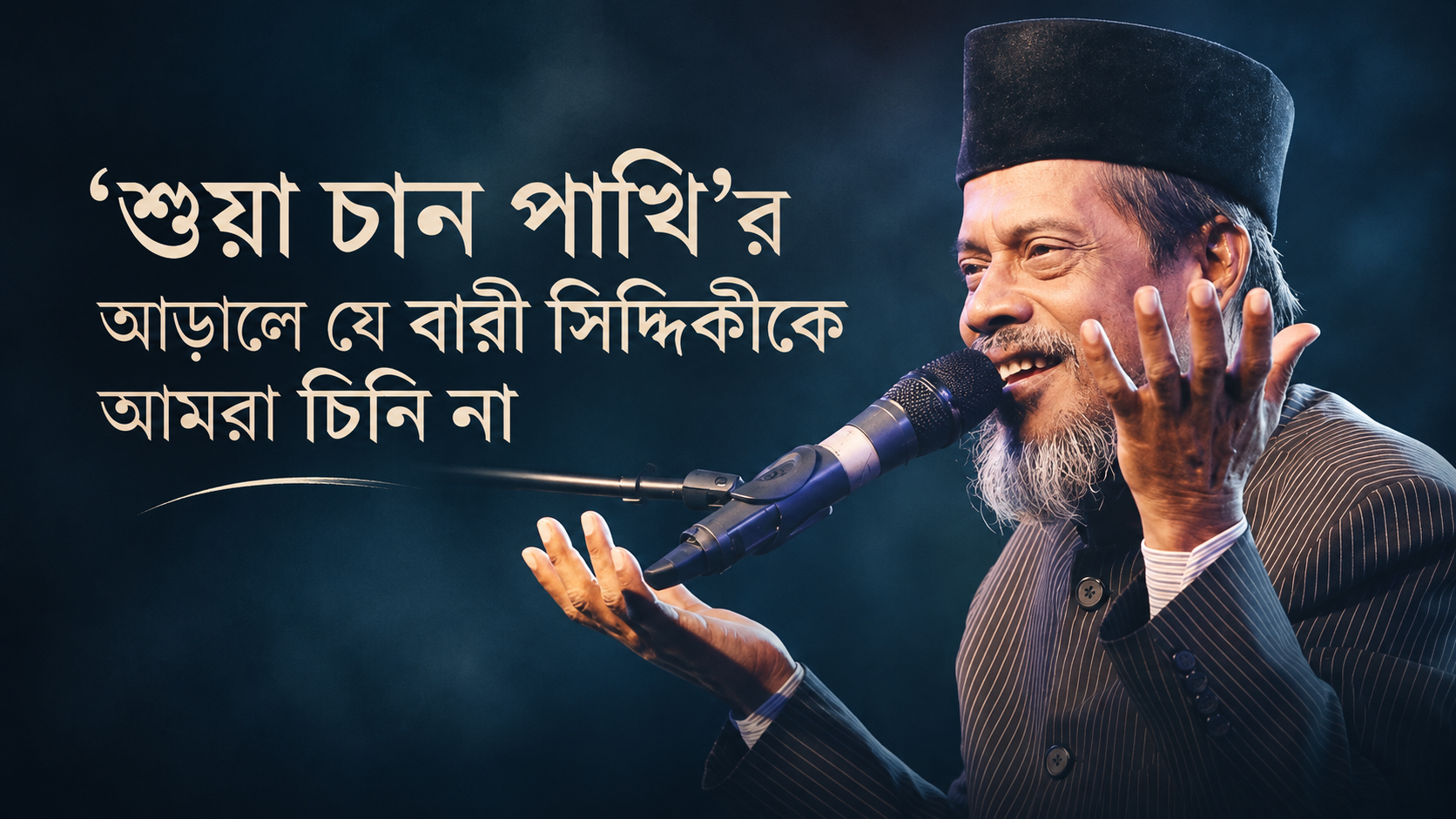

Published: 11:54 19 November 2026
Some voices in Bengali music feel as though someone is singing the story of their own life. They carry emotions of separation, longing, heartbreak, love and profound reflections on life. Bari Siddiqui was one such artist. Through songs like ‘Shua Chan Pakhi’, ‘Amar Gaye Joto Dukkho Soy’ and ‘Pubali Batase’, he did more than create music; he became a part of the personal emotions and memories of countless listeners.
But the story of this popular singer did not begin with singing. It began with the flute. Long before becoming a household name as a singer, he was a dedicated flautist who also earned recognition on international stages. Towards the end of his life, he dreamed of establishing an institution in his hometown dedicated to preserving folk music. He named that dream ‘Baul Bari’.
Born on November 15, 1954, in Netrokona, Bari Siddiqui passed away on November 24, 2017, at the age of just 63. Yet, the appeal of his music remains as powerful as ever.
Childhood: His Mother's Songs and His Elder Brother's Flute Inspired His Musical Journey
Bari Siddiqui's full name was Abdul Bari Siddiqui. He was born on November 15, 1954, in Fachika village, Kailati Union, Netrokona Sadar. His father was Moharram Ali, and his mother was Johur-un-Nisa. He was the youngest of three brothers and one sister.
His mother was his first music teacher. At just three or four years old, he became fascinated with music after hearing his mother sing ‘Shashurire Koiyo Giya’. By the age of seven or eight, he had started receiving basic musical training from her.
However, the biggest turning point in his early life came through the flute. At the age of five, he saw his elder brother playing the instrument and tried to imitate him. Gradually, this developed into a deep passion for the flute. Since there were limited opportunities to learn flute in Netrokona at the time, he taught himself by listening and practising independently.
An interesting fact about his childhood is that he once recreated on the flute a melody associated with the separation of Shyam, which he had heard from his mother. Years later, that very melody was used in Humayun Ahmed's film Shrabon Megher Din. A tune connected to his childhood memories eventually found its place on the big screen.
Nearly Two Decades of Dedication to the Flute Before Becoming a Singer
To understand Bari Siddiqui's musical journey, it is important to recognise his identity as a flautist. He did not initially establish himself as a singer. His professional musical career began with the flute.
While studying in high school, he received formal musical training from Ustad Gopal Dutta at the Netrokona District Shilpakala Academy. Later, after moving to Dhaka, he received advanced flute training from Ustad Aminur Rahman, who was a disciple of the renowned flautist Pannalal Ghosh.
He also travelled to Pune, India, to learn from Pandit V. G. Karnad. Training under both local and international music teachers helped him develop and refine his distinctive playing style.
He began playing the flute professionally in 1980. In 1986, he made his television debut by performing on BTV's programme ‘Srijon’. Later, he also served as a music director and principal instrumentalist at Bangladesh Television.
International Recognition for Bari Siddiqui's Flute Performances
Bari Siddiqui's reputation as a flautist extended beyond Bangladesh. In 1999, he participated in the World Flute Conference in France, representing Bangladesh on the international music stage. His participation as a South Asian representative was particularly noteworthy.
One remarkable aspect of his career was that even after becoming widely recognised as a singer across the country, he never abandoned his identity as a flautist. In fact, he felt more comfortable introducing himself as a flautist.
This distinction set him apart from many other popular folk musicians. For him, the flute was more than just a musical instrument; it was his first love and the foundation of his musical journey.
His Meeting with Humayun Ahmed and How Bari Siddiqui Became a Singer
Although Bari Siddiqui was already known as a flautist, the person who played a significant role in introducing him to the wider public as a singer was renowned writer and filmmaker Humayun Ahmed.
On one occasion, Bari Siddiqui was invited to perform the flute at Humayun Ahmed's birthday celebration. Alongside playing the flute, he also performed a few songs. Humayun Ahmed was impressed by his voice and encouraged him to sing more.
In 1995, Bari Siddiqui made his singing debut on BTV's programme ‘Ronger Baroi’, produced by Humayun Ahmed. Later, in 1999, he received the opportunity to sing in the film Shrabon Megher Din.
His performances of ‘Shua Chan Pakhi’, ‘Pubali Batase’, ‘Amar Gaye Joto Dukkho Soy’ and ‘Ogo Bhabijan’ in the film became hugely popular.
The man once recognised primarily as a flautist gradually became one of the most familiar voices in Bengali folk music. In an interview, Bari Siddiqui acknowledged that Humayun Ahmed's encouragement and confidence had helped him move forward as a singer.
Following the film's success, his albums ‘Dukkho Roilo Mone’ and ‘Aparadhi Hoileo Ami Tor’ also gained popularity among listeners. In April 2000, his folk music album ‘Lokkhi Tara’ was released.
The Songs That Made Bari Siddiqui a Part of People's Hearts
One of the greatest characteristics of Bari Siddiqui's music was its natural emotional expression. Rather than relying heavily on vocal ornamentation, he prioritised the feelings behind the lyrics. Whenever he sang about separation or heartbreak, listeners felt as though someone was expressing their own personal pain.
Some of his most popular songs include:
- Shua Chan Pakhi
- Amar Gaye Joto Dukkho Soy
- Pubali Batase
- Sare Tin Haat Kobor
- Manush Dhoro Manush Bhojo
- Ogo Bhabijan
- Jibon Jodi Bodol Kora Jeto
- Amar Mondho Shobhab
- Asharh Maisha Bhasha Panire
- Tumi Thako Karagare
- Rojoni
Many of these songs were written by folk poet and Baul mystic Ukil Munshi. Bari Siddiqui's special ability was to convey the emotional depth of these traditional compositions through his voice, introducing older folk songs to a new generation of listeners.
‘Shua Chan Pakhi’: The Deep Story of Grief Hidden Within a Song
Whenever Bari Siddiqui's name comes up, the first song that comes to mind for many people is ‘Shua Chan Pakhi’. Its popularity is not the only reason it holds a special place in people's hearts. Its lyrics and emotional depth make it particularly memorable.
To understand the song, it is important to consider the meaning of its title. A commonly accepted interpretation of ‘Shua Chan Pakhi’ is a beloved person or cherished bird lying down. Here, the bird is not an ordinary bird; it is a metaphorical expression used to address someone deeply loved.
There is a popular folk story associated with the song. According to the story, Baul musician Ukil Munshi once travelled to a distant village to perform. While he was away, he received news that his sick wife had passed away. It is said that after returning home, he sat beside her grave and composed the song.
However, there is no reliable evidence establishing this story as confirmed historical fact. It remains a popular narrative associated with the song.
The emotional depth of the song lies in its longing to call out to someone who has been lost, the pain of separation and the helplessness of knowing that the loved one will never return. Bari Siddiqui's powerful yet melancholic voice made these emotions even more profound.
‘Amar Gaye Joto Dukkho Soy’: More Than Enduring Pain, It Is About Love and Resentment
At first listen, ‘Amar Gaye Joto Dukkho Soy’ may sound like a complaint from someone who has suffered greatly. However, the song carries much deeper emotions.
Through its lyrics, a lover expresses the pain and neglect experienced at the hands of someone they deeply love. They understand that they have been hurt and that their affection has not received the value it deserved. Yet, despite everything, they continue to express their love and emotional attachment.
One of the most important themes in the song is the relationship between forgiveness, faith and the consequences of one's actions. Its message suggests that those who cause suffering to others may eventually have to face similar pain themselves.
It is therefore not simply a romantic song. It also carries a spiritual reflection on human behaviour, morality and the natural consequences of one's actions.
These humanistic and spiritual themes frequently appeared in Ukil Munshi's compositions. Through Bari Siddiqui's voice, the song brought these deeper emotions closer to ordinary listeners.
‘Pubali Batase’: A Song of Waiting and Loneliness
‘Pubali Batase’ carries a somewhat different emotional character. It expresses waiting, loneliness and the sadness of missing someone who has gone far away.
The natural beauty of the haor region, monsoon waters, boats and the longing for someone living far away are closely connected to the song's emotional atmosphere. It creates the image of someone looking towards nature while waiting for a loved one to return.
Listening to the song evokes not only the pain of separation but also the loneliness of rural life. This is one reason Bari Siddiqui's songs resonated with listeners in both urban and rural communities.
Why Did Listeners Love Him So Much?
An artist's popularity cannot be measured simply by the number of songs they have released. What truly matters is how deeply their music becomes connected to people's lives. This was particularly evident in the case of Bari Siddiqui.
His audience was not limited to folk music enthusiasts. Educated young people in cities, ordinary villagers and older generations all embraced his music.
Several factors contributed to his widespread popularity:
- Distinctive voice: His voice carried a deep, earthy quality and a distinctive sense of melancholy.
- Use of regional language: His songs featured simple, natural language that felt familiar and relatable to ordinary people.
- Emotional themes: Love, separation, resentment, death, humanity and spirituality were central themes in his music.
- Flute performances: His expertise as a flautist added another dimension to his musical performances.
- Introducing folk music to new audiences: Through cinema, he helped bring traditional folk songs to a new generation of listeners.
Following the announcement of his death in 2017, people from different professions and backgrounds expressed their grief. The public reaction to his passing, along with the continued popularity of his songs, demonstrated that he was not merely an artist of a particular era. His music had the ability to reach new generations as well.
Beyond Music: His Work in Acting and Other Creative Fields
Many people may not know that Bari Siddiqui also explored acting. He appeared in the film Matir Pinjira. He also acted in the drama Pagla Ghora, directed by Ferari Amit.
However, acting was never his primary profession. He became involved in these projects mainly through the encouragement of people close to him and his own personal interest.
Another notable aspect of his musical career was that he did more than perform songs. He also wrote lyrics and worked on musical compositions. His creative contributions extended far beyond those of an ordinary singer.
Family: His Wife, Two Sons and a Daughter
In his personal life, Bari Siddiqui was a family-oriented man. According to information published by various news outlets, he was survived by his wife, two sons and one daughter.
His eldest son, Sabbir Siddiqui, was involved in acting. His younger son, Bilash Siddiqui, pursued music. His only daughter, Elma Siddiqui, also followed in her father's footsteps and entered the music industry.
In 2018, Elma officially announced her debut in music. Her first album was titled ‘Bhalobashar Pore’. She has also shown an interest in preserving her father's musical legacy and memories.
One beautiful aspect of this story is that Bari Siddiqui's musical legacy was not limited to his recorded songs. His passion for music also inspired the next generation of his own family.
His Final Days: A Long Battle Against Illness
During the final years of his life, Bari Siddiqui suffered from several health complications. He had been living with diabetes and kidney problems for a long time. According to reports based on information from his family, he had been undergoing dialysis since the year before his death.
On November 17, 2017, he suffered a heart attack and was admitted to Square Hospital in Dhaka. As his condition deteriorated, he was transferred to the Intensive Care Unit (ICU). Despite the efforts of doctors, his health did not improve.
Finally, on Friday, November 24, 2017, at approximately 2:00 am, he passed away. He was 63 years old.
Following news of his death, people from across the music industry and different walks of life expressed their condolences.
The Dream That Lives on After His Death: Baul Bari
One of the most significant yet relatively less discussed chapters of Bari Siddiqui's life is ‘Baul Bari’ in Netrokona.
He established the institution in Karli village, near his birthplace. His objective was to preserve Bengali folk music, create opportunities for Baul and folk musicians to practise their art, and introduce younger generations to this traditional musical heritage.
He envisioned Baul Bari as more than just a place for musical practice. He wanted it to become a centre for research and training in folk music.
His relatives also revealed that he wanted to establish a training centre for Baul musicians there, alongside building a mosque featuring a tall minaret.
After his funeral in Dhaka on November 24, 2017, his body was taken to Netrokona. In accordance with his wishes, he was laid to rest beside Baul Bari.
This remains one of the most symbolic chapters of his life. A man who devoted much of his life to music ultimately found his final resting place beside the musical institution he had built with his own hands.
Why Does Bari Siddiqui Remain Relevant Today?
Times have changed, musical styles have evolved, and the ways younger generations discover and enjoy music are very different today. Yet, people continue to listen to Bari Siddiqui's songs.
One reason is that his music was never dependent on the trends of a particular era. Instead, it explored timeless human emotions such as love, separation, waiting, suffering, forgiveness and thoughts of mortality.
Listening to his songs often feels like hearing someone share their own life story. Perhaps that is why ‘Shua Chan Pakhi’ reminds some listeners of someone they have lost, ‘Amar Gaye Joto Dukkho Soy’ brings back feelings of personal resentment, while ‘Pubali Batase’ reminds others of an old afternoon spent waiting for someone who never returned.
Bari Siddiqui was more than a popular singer. He was a dedicated flautist, a passionate explorer of folk music and an artist deeply committed to his cultural roots.
Perhaps his greatest legacy is this: he never abandoned his musical roots in pursuit of popularity. Instead, he created melodies from those very roots that continue to find a place in people's hearts even today.
Advertisement
Most Readed - Biography

- Bangladesh Aims to Launch Indigenous Satellite into Space Within Three Years
- Bari Siddiqui: The Voice Behind ‘Shua Chan Pakhi’ and the Untold Story of a Legendary Folk Musician
- Rohingya Genocide Case: ICJ to Deliver Historic Verdict Against Myanmar Today
- Cyclone ‘Akvan’: Signal No. 3 Issued at Four Bangladesh Seaports
- UN Expresses Concern Over Attacks on Grameen Bank, Calls for Thorough Investigation
- Pakistan Plans to Divide Four Provinces into 14, New Map Under Discussion
- Legal Notice Sent to Government to Bring Sheikh Hasina Back from India
- Robert Pattinson Announced as the New James Bond, Replacing Daniel Craig
- US Intelligence Claims Iran Is Planning a Dirty Bomb Attack in Washington
- Garment Workers’ New Minimum Wage Meeting Rescheduled for November 23
- Notice Regarding October 29 HSC Result Publication Is Fake: Board Issues Warning
- From Shah Rukh to Salman: The Security Categories Assigned to Top Bollywood Stars
- Who Can Get a Free Verified Badge on Facebook? Eligibility and Conditions
- Body of former Flight Lieutenant—who released a video of Sheikh Hasina’s departure recovered!
- Two Warranted Accused Arrested in Khoksa Police Raids, Including Zakir Hasan Masud
- Physics Tests Completed for Rooppur’s First Unit; Awaiting the Next Phase Toward Power Generation
- Minimum Wage Board to Meet on November 9 to Determine New Wages for Garment Workers
- Government to Provide Up to 2 Million Taka to Young Entrepreneurs; Applications Open in 56 Districts
- Hanging Body of Businessman Recovered from His Own Warehouse in Khoksa
- Garment workers block roads once again, demanding fair wages