Biography of Begum Khaleda Zia: From Homemaker to Bangladesh’s First Female Prime Minister and a Long Struggle for Democracy

Published: 03:48 9 August 2026
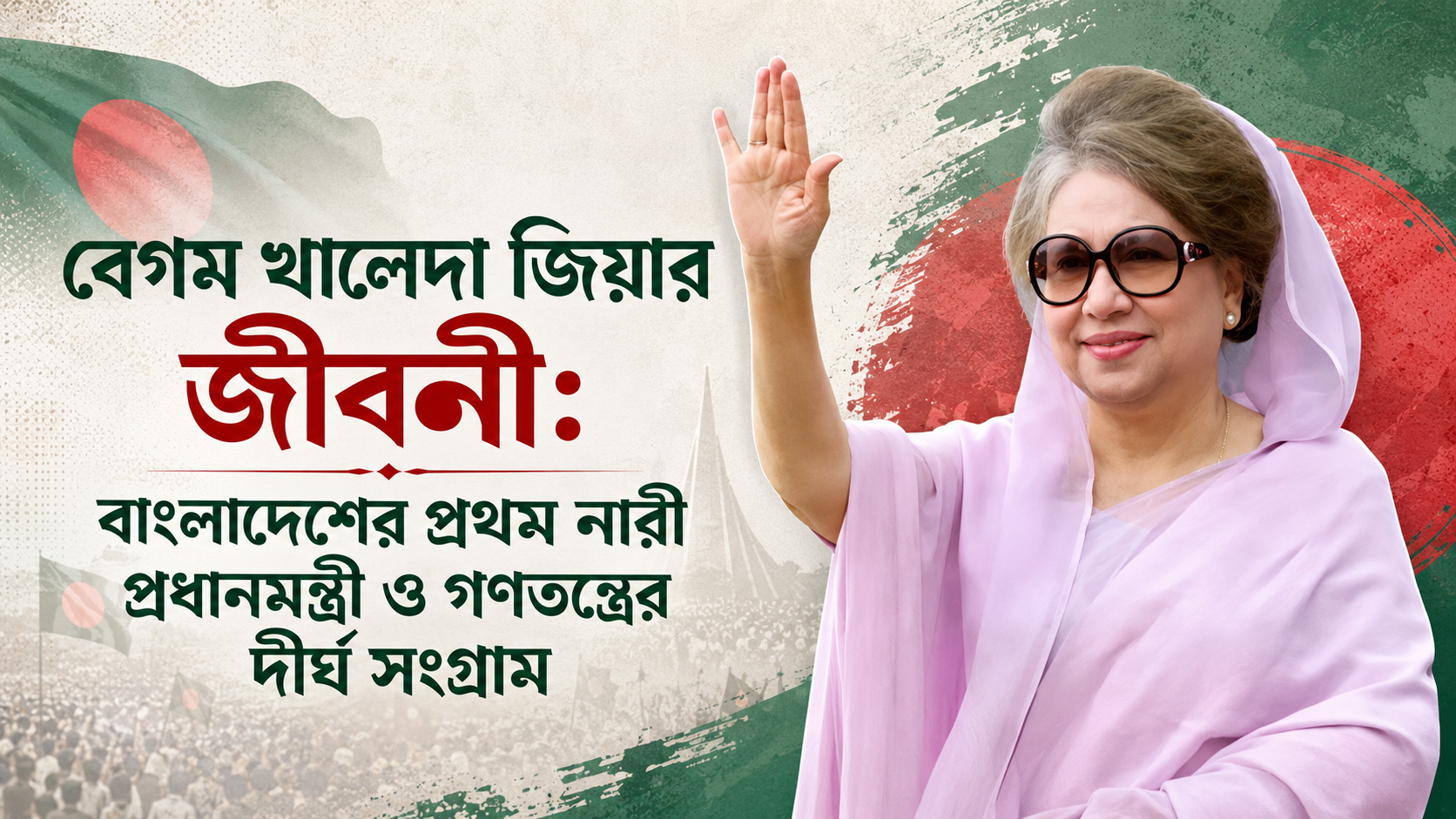
Begum Khaleda Zia is one of the most influential political figures in the history of post-independence Bangladesh. Her life represents an extraordinary transformation: from a private homemaker who remained outside active politics for many years to the leader of one of the country’s largest political parties, a central figure in the anti-autocracy movement, Bangladesh’s first female prime minister, a long-serving opposition leader, a prisoner, and eventually one of the most recognisable symbols of Bangladeshi politics.
For more than four decades, she remained at the centre of the Bangladesh Nationalist Party, commonly known as the BNP. At the same time, her long political rivalry with Sheikh Hasina shaped the direction of Bangladeshi politics for decades.
Khaleda Zia’s political career was filled with major achievements, electoral victories, popular support, political confrontation, legal battles, imprisonment, illness, and controversy. For this reason, her biography is not simply the story of one politician. It is also a story of Bangladesh’s democratic transition, political polarisation, power struggles, and changing political institutions.
Birth, Family, and Childhood
There are differences among public records regarding Begum Khaleda Zia’s exact year and place of birth. Some sources list her date of birth as 15 August 1946, while others mention 15 August 1945.
Her father was Iskandar Majumder and her mother was Taiyaba Majumder. After the Partition of India, her family settled in Dinajpur. Her ancestral family roots were connected to the Feni region of present-day Bangladesh.
Khaleda Zia spent part of her early life in Dinajpur and attended school there. She studied at Dinajpur Missionary School and later at Dinajpur Girls’ School. She subsequently continued her studies at Surendranath College in Dinajpur.
At that time, there was little indication that this relatively private young woman would one day become one of the most powerful political leaders in Bangladesh.
Marriage to Ziaur Rahman
In 1960, Khaleda Zia married Ziaur Rahman, who was then an officer in the Pakistan Army.
Ziaur Rahman later played an important role in Bangladesh’s Liberation War and subsequently became President of Bangladesh.
After marriage, Khaleda Zia largely lived the life of a military officer’s wife. Because of her husband’s postings, the family lived in different locations. During this period, she stayed away from active political life.
The couple had two sons, Tarique Rahman and Arafat Rahman Koko.
Tarique Rahman later became one of the most influential leaders of the BNP and eventually emerged as the party’s principal political successor.
Khaleda Zia During the Liberation War
The Liberation War of 1971 brought enormous changes to the lives of Khaleda Zia and her family.
When the war began, Ziaur Rahman joined the rebellion against the Pakistan Army and participated in the Liberation War.
During the conflict, Khaleda Zia and her children faced uncertainty and hardship. She was reportedly taken into custody by the Pakistani military during the war and remained under restriction until the independence of Bangladesh.
After Bangladesh achieved victory on 16 December 1971, she was released.
This was an extremely difficult period of her personal life. Her husband was involved in the war, while she had to protect and care for her children under dangerous and uncertain circumstances.
After independence, Ziaur Rahman gradually became an important figure in Bangladesh’s military and political structure. As a result, Khaleda Zia’s life also moved closer to the country’s political and state institutions.
Life as First Lady
After Ziaur Rahman became President of Bangladesh, Khaleda Zia served as the country’s First Lady.
During this period, she attended various official and international events with her husband and became more familiar with state affairs and diplomatic life.
She met foreign dignitaries and participated in official programmes, but she was still not considered an active political leader in her own right.
Her direct entry into politics would come later, under tragic circumstances.
The Assassination of Ziaur Rahman and a Turning Point in Her Life
On 30 May 1981, President Ziaur Rahman was assassinated in Chattogram during a failed military coup.
His death completely changed Khaleda Zia’s personal life.
At the same time, it ultimately opened the path for her entry into politics.
Following Ziaur Rahman’s death, the BNP faced a leadership crisis. Many party leaders and supporters believed that Khaleda Zia could play an important role in preserving the party’s unity and maintaining Ziaur Rahman’s political legacy.
She formally joined the BNP as an ordinary member on 2 January 1982.
In March 1983, she became the party’s vice-chairperson.
In August 1984, she was elected chairperson of the Bangladesh Nationalist Party.
This marked the beginning of her transformation from a politically inexperienced widow into the leader of one of Bangladesh’s largest political parties.
Leadership in the Anti-Ershad Movement
In March 1982, Army Chief Hussain Muhammad Ershad seized power and established military rule in Bangladesh.
Khaleda Zia became one of the major leaders of the movement against Ershad.
The Awami League and other opposition groups also participated in the anti-autocracy movement. Although the BNP and Awami League often operated through different political alliances, both played significant roles in putting pressure on the Ershad government.
Between 1983 and 1990, Khaleda Zia was detained several times while participating in anti-government movements.
Her supporters later began describing her as an “uncompromising leader” because of her refusal to reach a political settlement with the military government.
By 1990, nationwide demonstrations, student movements, political strikes, and opposition mobilisation had severely weakened the Ershad regime.
In December 1990, Ershad stepped down.
The anti-autocracy movement established Khaleda Zia as a nationally recognised political leader and significantly increased her popularity.
The 1991 Election and Bangladesh’s First Female Prime Minister
Bangladesh held a national parliamentary election on 27 February 1991.
The BNP emerged as the largest party in parliament.
Following the election, Khaleda Zia took the oath of office as Prime Minister on 20 March 1991.
With this, she became the first female Prime Minister of Bangladesh.
Her rise to power was historically significant.
She became the head of government at a time when women’s participation in senior political leadership across South Asia was still relatively limited.
Her premiership also marked a new stage in Bangladesh’s return to parliamentary democracy after years of military-backed rule.
Return to the Parliamentary System of Government
One of the most important constitutional developments during Khaleda Zia’s first government was the restoration of the parliamentary system.
Bangladesh had moved toward a presidential form of government after the political changes of the 1970s.
In 1991, the BNP government and opposition parties reached a broad political understanding regarding the restoration of parliamentary democracy.
The Twelfth Amendment to the Constitution was passed.
Under the new arrangement, the President became the constitutional head of state, while the Prime Minister became the effective head of government.
On 19 September 1991, Khaleda Zia again took the oath as Prime Minister under the restored parliamentary system.
For this reason, her first administration holds an important place in the history of Bangladesh’s parliamentary democracy.
Education and Social Initiatives During Her First Government
The Khaleda Zia government introduced several important initiatives in education and social development between 1991 and 1996.
Policies were adopted to expand primary education and increase school participation.
Her government also encouraged girls’ education through tuition support and stipend programmes.
The Female Secondary School Stipend Programme became particularly significant because it encouraged more girls to remain in school.
The government also introduced initiatives such as Food for Education, designed to provide incentives to poor families to send their children to school.
Supporters of Khaleda Zia frequently cite these programmes as some of the most important social achievements of her first administration.
Her government also pursued economic liberalisation and policies intended to increase private-sector activity and foreign investment.
The Beginning of the Long Rivalry with Sheikh Hasina
Although Khaleda Zia and Sheikh Hasina participated in the broader struggle against Ershad’s rule, their political relationship changed rapidly after the restoration of parliamentary democracy.
The BNP, led by Khaleda Zia, and the Awami League, led by Sheikh Hasina, emerged as Bangladesh’s two dominant political forces.
Their rivalry became one of the defining features of Bangladeshi politics for the next several decades.
Disagreements developed over elections, parliamentary participation, strikes, caretaker governments, political violence, and the role of state institutions.
The rivalry created intense electoral competition.
At the same time, critics argue that it contributed to deep political polarisation, a culture of confrontation, repeated parliamentary boycotts, and distrust between major political parties.
The 1996 Political Crisis and the Caretaker Government System
Toward the end of Khaleda Zia’s first term, a major political crisis developed over the question of how national elections should be conducted.
The Awami League and other opposition parties argued that a credible election could not take place under a sitting partisan government.
They demanded that parliamentary elections be held under a neutral caretaker government.
From 1994 onward, opposition protests, parliamentary boycotts, resignations, strikes, and street movements intensified the crisis.
A national election was held in February 1996 without the participation of the major opposition parties.
The BNP won the election, and Khaleda Zia again became Prime Minister.
However, the opposition continued its movement.
Under intense political pressure, the government amended the Constitution to establish the caretaker government system.
Khaleda Zia then stepped down, allowing a neutral caretaker administration to oversee a new national election.
Her second premiership in 1996 was therefore extremely brief.
1996 to 2001: Politics in Opposition
In the June 1996 election, the Awami League won enough seats to form the government, and Sheikh Hasina became Prime Minister.
Khaleda Zia became Leader of the Opposition.
During this period, the BNP focused on rebuilding its organisational strength, campaigning against the government, and preparing for the next parliamentary election.
Political distrust between the BNP and Awami League continued to grow.
Bangladesh’s political system increasingly became dominated by rivalry between these two major parties and their leaders.
Return to Power in 2001
The BNP returned to power after the national election held on 1 October 2001.
The party achieved a major electoral victory and formed a coalition government.
Khaleda Zia took office again as Prime Minister on 10 October 2001.
This marked the beginning of her second full term in government, lasting from 2001 to 2006.
Her administration pursued policies related to economic growth, private-sector expansion, infrastructure, trade, and investment.
However, this period was also marked by major controversies involving political violence, allegations of corruption, the rise of militant organisations, and conflict with the opposition.
2001–2006: Achievements and Controversies
Khaleda Zia’s second full term remains one of the most debated periods of her political career.
Her supporters point to economic activity, private-sector growth, infrastructure development, export expansion, and improvements in some social indicators.
Critics, however, raise concerns about corruption, political violence, the politicisation of state institutions, and the rise of extremist groups during this period.
One of the most serious incidents was the grenade attack on an Awami League rally on 21 August 2004.
The attack targeted a rally attended by Sheikh Hasina and killed 24 people while injuring hundreds.
The incident became one of the most controversial episodes in Bangladesh’s modern political history.
Questions regarding responsibility, investigation, prosecution, and later court decisions continued for many years.
For this reason, assessments of Khaleda Zia’s second government usually include both its economic and administrative record and the highly confrontational political environment of the period.
The 2006 Political Crisis and the Military-Backed Caretaker Government
After Khaleda Zia’s government completed its term in 2006, another major political crisis emerged over the leadership and neutrality of the caretaker government.
Opposition parties questioned the neutrality of the election process and Election Commission.
Street protests and political clashes intensified.
The scheduled January 2007 election was eventually cancelled.
A state of emergency was declared, and a military-backed caretaker government led by Fakhruddin Ahmed took power.
The caretaker administration launched an anti-corruption campaign and targeted political leaders from both the BNP and Awami League.
Khaleda Zia and Sheikh Hasina were both arrested during this period.
The political strategy was widely associated with what became known as the “Minus Two” formula, an alleged attempt to remove both dominant political leaders from national politics.
This marked another major period of imprisonment and uncertainty in Khaleda Zia’s career.
Long Opposition Politics After 2008
The Awami League-led alliance won a landslide victory in the 2008 national election.
The BNP returned to opposition politics.
Khaleda Zia remained the principal leader of the opposition to Sheikh Hasina’s government.
In 2014, the BNP and its allies boycotted the national election after failing to reach an agreement over an election-time caretaker government.
The Awami League consequently remained in power.
The election boycott had significant consequences for the BNP.
The party lost parliamentary representation and increasingly relied on street movements and political campaigns.
Khaleda Zia remained the central figure in opposition politics, but the political environment became increasingly difficult for her party.
The 2018 Corruption Case and Imprisonment
On 8 February 2018, Khaleda Zia was sentenced to five years in prison in the Zia Orphanage Trust corruption case.
The prosecution accused her and others of misappropriating funds that had been donated to an orphanage trust.
Khaleda Zia and the BNP rejected the allegations.
They argued that the cases were politically motivated and designed to prevent her from participating in elections.
Later, she also received a prison sentence in another corruption case involving the Zia Charitable Trust.
Because of the convictions, she was unable to contest the 2018 national election.
Her imprisonment significantly affected the internal politics of the BNP.
Tarique Rahman, who was living in London, became increasingly important in the party’s leadership structure.
Illness and Conditional Release in 2020
Khaleda Zia’s health deteriorated significantly during and after her imprisonment.
In March 2020, the government temporarily suspended her prison sentence on humanitarian grounds and allowed her to return home for medical treatment.
The release came with conditions.
She was required to remain in Bangladesh and receive treatment at home rather than travel abroad.
The suspension of her sentence was later extended several times.
She stayed primarily at her Gulshan residence, known as Firoza.
During this period, doctors and media reports described multiple health complications, including liver cirrhosis, heart problems, kidney complications, diabetes, and other age-related illnesses.
Her declining health significantly reduced her direct participation in active politics.
However, she continued to hold enormous symbolic importance within the BNP.
The 2024 Mass Uprising and Khaleda Zia’s Release
Bangladesh experienced a dramatic political transformation in July and August 2024.
A student-led movement that had initially focused on reforms to the government job quota system developed into a wider anti-government uprising.
On 5 August 2024, Sheikh Hasina resigned as Prime Minister and left the country.
The following day, the President dissolved parliament, and measures were taken to release Khaleda Zia from the restrictions associated with her suspended sentence.
The political environment changed rapidly.
An interim government led by Dr. Muhammad Yunus later took office.
For Khaleda Zia and the BNP, the fall of the Awami League government created a new political environment after years of restrictions and conflict.
Acquittal in Major Cases
Important legal developments involving Khaleda Zia took place during 2024 and 2025.
In November 2024, she was acquitted in one corruption case.
Then, on 15 January 2025, Bangladesh’s Supreme Court acquitted Khaleda Zia, Tarique Rahman, and others in the Zia Orphanage Trust case.
The earlier conviction was overturned.
As a result, one of the most politically significant legal cases against her no longer remained legally effective.
This was an important development during the final stage of her political life because the convictions had directly affected her freedom and political participation for several years.
Travel to London for Medical Treatment
In January 2025, Khaleda Zia travelled to London for advanced medical treatment.
Because of her serious health condition, she was transported from Dhaka by a specially arranged air ambulance.
She was suffering from multiple complications involving her liver, heart, kidneys, and other conditions.
Her trip was also emotionally significant because she was reunited with members of her family after a long period.
After receiving treatment in London for several months, she returned to Bangladesh on 6 May 2025.
By then, however, her age and health condition prevented her from returning to the level of active political campaigning she had once maintained.
Despite this, she remained the symbolic senior leader and political guardian of the BNP.
Final Days and Death
Khaleda Zia’s health deteriorated again toward the end of 2025.
She received treatment at Evercare Hospital in Dhaka.
On 30 December 2025, Begum Khaleda Zia died after a prolonged period of illness.
Her death marked the end of one of the longest and most influential political careers in Bangladesh.
The government announced three days of state mourning, and the day of her funeral was declared a public holiday.
A massive funeral prayer was held in the area surrounding the National Parliament complex.
Large numbers of supporters, political leaders, ordinary citizens, and representatives from different sections of society attended.
She was later buried with state honours beside her husband, Ziaur Rahman, at Zia Udyan in Dhaka.
More Than Four Decades of BNP Leadership
One of the most remarkable aspects of Khaleda Zia’s political career was the length of her leadership of the Bangladesh Nationalist Party.
After becoming chairperson in 1984, she remained the central figure of the party for more than four decades.
Under her leadership, the BNP participated in the anti-military movement, won multiple national elections, formed governments, and spent long periods as the principal opposition party.
Among her supporters, she became widely known as an uncompromising political leader.
Her personal authority played an important role in maintaining party unity during periods of political crisis.
However, her leadership was also criticised.
Critics raised questions about dynastic politics, internal party democracy, political confrontation, alliances with Islamist political groups, and controversies surrounding her governments.
Importance of Khaleda Zia in Women’s Political Leadership
Khaleda Zia occupies an important position in the history of women’s political leadership in Bangladesh.
She became Prime Minister at a time when women’s participation in political and economic leadership was still significantly limited.
For decades, she served as Prime Minister, Leader of the Opposition, and leader of one of the country’s largest political parties.
Her rise demonstrated that a woman could occupy the highest levels of political power in a conservative South Asian society.
At the same time, the long dominance of Khaleda Zia and Sheikh Hasina also created an interesting contradiction.
Although Bangladesh had women at the top of national politics for decades, women remained underrepresented at many lower and middle levels of political leadership.
Sheikh Hasina vs Khaleda Zia: An Era of Bangladeshi Politics
From the early 1990s until the political changes of 2024, much of Bangladesh’s politics revolved around the rivalry between Sheikh Hasina and Khaleda Zia.
Both came from influential political families.
Khaleda Zia was the widow of President Ziaur Rahman, while Sheikh Hasina was the daughter of Sheikh Mujibur Rahman.
They had participated in the broader movement against Ershad, but later became each other’s principal political opponent.
Their rivalry shaped elections, parliamentary politics, street movements, alliances, protests, and public debate.
Supporters of both leaders viewed their respective political positions as essential to the future of Bangladesh.
Critics, however, argue that their prolonged rivalry contributed to political confrontation, deep partisan divisions, election boycotts, strikes, and a culture of political revenge.
Whether viewed positively or negatively, their rivalry defined an entire era of Bangladeshi politics.
Khaleda Zia’s Political Legacy
Khaleda Zia’s political legacy is complex and cannot be reduced to a single narrative.
To her supporters, she was an uncompromising leader of the anti-autocracy movement, a major figure in the restoration of parliamentary democracy, Bangladesh’s first female Prime Minister, and the symbol of unity within the BNP.
The restoration of parliamentary government during her first administration remains one of the most important achievements associated with her leadership.
Her government’s programmes supporting female education and other social initiatives are also frequently highlighted.
Her critics, however, point to political violence, allegations of corruption, confrontation with opposition parties, alliances with Jamaat-e-Islami, political polarisation, and controversies surrounding governance during BNP rule.
A balanced historical assessment of Khaleda Zia therefore requires consideration of both her achievements and the controversies associated with her political career.
A New Chapter for the BNP After Her Death
Khaleda Zia’s death did not end the political influence of her family or party.
Her son Tarique Rahman had already become the principal operational leader of the BNP.
Following the political changes after 2024 and Khaleda Zia’s death, the BNP entered a new phase under his leadership.
In February 2026, the BNP won the national election and returned to government.
Tarique Rahman subsequently became Prime Minister of Bangladesh.
This transition represented a generational change in BNP leadership.
It also demonstrated that Khaleda Zia’s political legacy remained directly connected to contemporary Bangladeshi politics even after her death.
Why Is the Biography of Begum Khaleda Zia Important?
Understanding the biography of Begum Khaleda Zia helps readers understand much of Bangladesh’s political history over the last four decades.
Her life was directly or indirectly connected with many of the country’s most important political events:
the anti-Ershad movement, the 1990 mass uprising, the restoration of parliamentary democracy, the creation of the caretaker government system, the rivalry between the BNP and Awami League, election-related political crises, the military-backed caretaker government of 2007, her imprisonment in 2018, the political transformation of 2024, and the BNP’s return to power in 2026.
For this reason, Khaleda Zia’s political journey provides an important window into the development of modern Bangladeshi politics.
Conclusion
Begum Khaleda Zia did not begin her life as a politician.
She was initially the wife of a military officer, later the wife of the President of Bangladesh, and the country’s First Lady.
The assassination of her husband, Ziaur Rahman, completely changed the direction of her life.
From a politically inexperienced homemaker, she became chairperson of the BNP.
She led movements against military rule, faced repeated detention, and emerged as one of the most powerful opposition leaders in the country.
In 1991, she became Bangladesh’s first female Prime Minister.
During her first administration, the parliamentary system of government was restored, while several important education and social programmes were introduced.
At the same time, her political career became closely associated with intense partisan competition, election disputes, corruption allegations, political polarisation, imprisonment, and long-running confrontation with the Awami League.
Her active political life became increasingly limited after her imprisonment in 2018 and the deterioration of her health.
Following the political changes of 2024, she was released from restrictions, and major corruption convictions against her were subsequently overturned.
Her long political journey finally came to an end with her death on 30 December 2025.
She was buried with state honours beside her husband, Ziaur Rahman.
Yet her political story did not end with her death.
In 2026, the BNP returned to power under the leadership of her son, Tarique Rahman, beginning a new chapter in the political movement that Khaleda Zia had led for more than four decades.
History may not judge every decision she made in the same way.
Her supporters and critics will continue to interpret her legacy differently.
But one conclusion is difficult to dispute:
It is almost impossible to write the political history of Bangladesh over the last four decades without discussing Begum Khaleda Zia.
Her transformation from a homemaker to an anti-autocracy leader, Bangladesh’s first female Prime Minister, a long-serving opposition figure, an imprisoned politician, and one of the country’s most influential political symbols will remain a distinctive chapter in the history of Bangladesh.
Advertisement
Most Readed - Biography

- Highway blockade in Tentulia to protest sexual abuse of child, demand arrest and punishment
- Dhallywood King Shakib Khan: From Blockbuster Movies to Marriage and Controversies
- Mayoral candidate Nasim Mondal faces the public at a courtyard meeting in Sreepur
- Tokyo, not Bangkok, is becoming the new center of sex tourism
- 2,894 MW load shedding expected in the afternoon, suffering may increase at night
- Ziaul Ahsan arrested in Salahuddin Ahmed disappearance case
- Awami League's crimes can be called minor compared to Jamaat: Rashed Khan
- Shabnur The Sweetheart of Dhallywood Who Captivated an Entire Generation
- UEFA preparing case against Infantino
- Pakistan activated spies and sleeper cells in India due to fear of S-400
- Prime Minister Tarique Rahman to visit US for 10 days, address UN General Assembly in September
- Venues for the 2027 ODI Cricket World Cup finalized, 12 stadiums in three countries to host the world stage
- Aryan Khan with a mysterious young woman in London, new love rumors
- I never thought of such a wonderful debut in Dhaka cinema: Madhumita Sarkar is excited
- Saudi Arabia's new maritime alliance with 14 countries, including Bangladesh, to protect waterways
- Rainfall intensity may increase again, threat of heavy rainfall in several areas
- Facebook profile was red-faced on Tarique Rahman's advice, claims Chhatra Dal leader
- Kangana Ranaut slams Naseeruddin Shah for calling him a 'fox'
- Who is Ruhul Kabir Rizvi? Education, political life and current responsibilities
- Even though I am in government, I have not forgotten the struggle on the streets and the politics of the people: Ishraq Hossain